Y. Tokunaga, X. Z. Yu, J. S. White, H. M. Rønnow, D. Morikawa, Y. Taguchi, Y. Tokura
Nature Communications 6, 7638 (2015)
 |
Lorentz transmission electron microscopy (LTEM) of skyrmion crystal. |
|
Lorentz transmission electron microscopy (LTEM) of skyrmion crystal. |
 |
| a, In a Bloch-type skyrmion, the spins rotate in the tangential planes—that is, perpendicular to the radial directions—when moving from the core to the periphery. b, In a Néel-type skyrmion, the spins rotate in the radial planes from the core to the periphery. The cross-section of the vortex is also depicted in both cases. |
 |
| Spin patterns in the magnetic phases of GaV4S8. |
 |
| The frequency of the lowest vortex gyrotropic mode vs. dot thickness, ω0(L) 2p: red squares – the experimental data, blue solid line – the simulated frequencies, green solid line – the calculations according to Eq. (4) accounting vortex mass, black dashed line – calculations without accounting for the vortex mass. |
 |
| (a) The M-H hysteresis loops measured under HFC = 0.2 kOe and 50 kOe at T = 2 K for a Fe11Au89(50 nm)/FeNi(5 nm) sample, (b) the calculated M-H hysteresis loops under HFC = 0.2 kOe and 50 kOe at T = 2.6 K for the SG/FM bilayers, and the experimental (c) and calculated (d) cooling field dependences of low-temperature HE and HC. |
| (Top) The time variation of domain wall displacement with different
current densities. (Bottom) The initial DW velocity as a function of
current density: The critical current density, minimum current density
required to move DW is |
 |
| Using dynamic cantilever magnetometry we measure an enhanced skyrmion lattice phase extending from around 29 K down to at least 0.4 K in single MnSi nanowires (NWs). Although recent experiments on two-dimensional thin films show that reduced dimensionality stabilizes the skyrmion phase, our results are surprising given that the NW dimensions are much larger than the skyrmion lattice constant. Furthermore, the stability of the phase depends on the orientation of the NWs with respect to the applied magnetic field, suggesting that an effective magnetic anisotropy, likely due to the large surface-to-volume ratio of these nanostructures, is responsible for the stabilization. The compatibility of our technique with nanometer-scale samples paves the way for future studies on the effect of confinement and surfaces on magnetic skyrmions. |


 |
| Magnetic nanoparticle hyperthermia is promising as a cancer therapeutic treatment. Shape and size are two crucial factors for the magnetic hyperthermia performance of nanoparticles. In this work, octahedral Fe3O4 nanoparticles with different sizes are successfully synthesized and their magnetic hyperthermia performances are investigated systematically in a gel suspension. The results suggest a wide size range (43–98 nm) for high SAR values (up to 2629 W g−1). The SAR values are verified by hysteresis loss measured in the gel suspension. This study demonstrates that octahedral Fe3O4 nanoparticles can serve as an excellent thermal seed for high performance magnetic hyperthermia cancer treatment. |
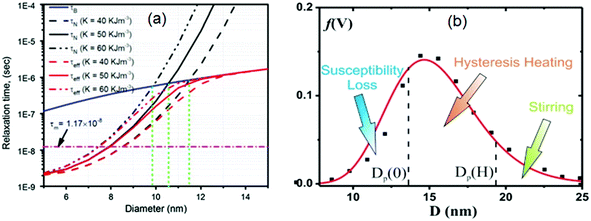 |
| (a) Graphical representation of Brownian, Néel and effective relaxation times as a function of particle diameter for different values of anisotropy constant (K)4 and (b) representation of heating due to Néel and Brownian relaxations, and hysteresis loss |
 |
| The magnetic moment configuration calculated by micromagnetic simulation for (a) 28 Å, (b) 38 Å, (c) 42 Å and (d) 72 Å iron thicknesses on 400 nm diameter spheres. The blue color represents the magnitude of the z component while the red stands for the x–y in-plane component. The non-magnetic part of the iron layer is shown in gray. |
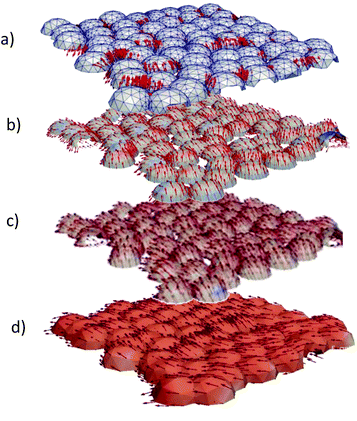 |
| Magnetic moment configuration calculated by micromagnetic simulation for (a) 26 Å, (b) 34.5 Å, (c) 48.5 Å and (d) 70.5 Å evaporated iron thickness on 25 nm diameter spheres. The blue color represents the magnitude of the z component while the red stands for the x–y in-plane component. |
 |
| An γFe2O3@Au core/shell-type magnetic gold nanoflower-based theranostic nanoplatform is developed. It is integrated with ultrasensitive surface-enhanced Raman scattering imaging, high-resolution photoacoustics imaging, real-time magnetic resonance imaging, and photothermal therapy capabilities |
 |
| The red arrows represent the orientation of the spin moments. Note that the third layer dominantly exhibits a paramagnetic behaviour. The left inset represents the second-ML molecule on top of the semi-transparent first-ML molecule. The right inset shows the relative alignment of the second-ML molecule (semi-transparent) to the third-ML molecule. |
| The spin-wave-amplitude decay along the rod, for a spin wave excited locally by applying a microwave |
| Temperature-dependent ZFC and FC magnetizations for (a) Au-4 sample and (b) free solution of |
| Ratio between the relaxation times |
| Magnetization distributions in the helix wire with easy-tangential anisotropy and |
| Equilibrium magnetization distribution in the quasitangential state of the helix wire with |
| (a) Schematic representation of the |
 |
| Size dependence of TV for Fe3O4 NCs. The contour plot represents the heat capacity data after removing the contribution of surfactant. The symbols mark the Verwey transition temperature (TV) determined from three different types of measurements: heat capacity (green, CP/T), conductance (blue, G), and magnetic moment (red, m). The size dependence of blocking temperature (TB) is also plotted from the same magnetization measurement (black). The gray line is a guide to the eye for the size dependence of TB. |
 |
| In this work, we studied the dynamic and static magnetic properties of ZnO-core/CoFe2O4-shell and CoO-core/CoFe2O4-shell nanoparticles. Both systems are formed by a core of ∼4 nm of diameter encapsulated in a shell of ∼2 nm of thickness. The mean blocking temperature changes from 106(7) to 276(5) K when the core is diamagnetic or antiferromagnetic, respectively. Magnetic remanence studies revealed the presence of weak dipolar interparticle interactions, where Hint is approximately −0.1 kOe for ZnO/CoFe2O4 and −0.9 kOe for CoO/CoFe2O4, playing a minor role in the magnetic behavior of the materials. Relaxation experiments provided evidence that the magnetization reversal process of CoFe2O4 is strongly dependent on the magnetic order of the core. At 10 K, activation volumes of ∼46(6) and ∼69(5) nm3 were found for CoO/CoFe2O4 and ZnO/CoFe2O4 nanoparticles, respectively, corresponding to one-third and one-fifth of the total shell volume. While the magnetic behavior of ZnO/CoFe2O4 nanoparticles is strongly affected by the surface disorder, the exchange coupling at the CoO/CoFe2O4 interface rules the magnetization reversal and the nanoparticles’ thermal stability by inducing a larger energy barrier and promoting smaller switching volume. |

 |
| One current challenge of magnetic hyperthermia is achieving therapeutic effects with a minimal amount of nanoparticles, for which improved heating abilities are continuously pursued. However, it is demonstrated here that the performance of magnetite nanocubes in a colloidal solution is reduced by 84% when they are densely packed in three-dimensional arrangements similar to those found in cell vesicles after nanoparticle internalization. This result highlights the essential role played by the nanoparticle arrangement in heating performance, uncontrolled in applications. A strategy based on the elaboration of nano-objects able to confine nanocubes in a fixed arrangement is thus considered here to improve the level of control. The obtained specific absorption rate results show that nanoworms and nanospheres with fixed one- and two-dimensional nanocube arrangements, respectively, succeed in reducing the loss of heating power upon agglomeration, suggesting a change in the kind of nano-object to be used in magnetic hyperthermia. |
 |
| Magnetic moment configuration calculated by micromagnetic simulation for (a) 26 Å, (b) 34.5 Å, (c) 48.5 Å and (d) 70.5 Å evaporated iron thickness on 25 nm diameter spheres. The blue color represents the magnitude of the z component while the red stands for the x–y in-plane component. |
 |
(a)–(d) Magnetic hysteresis loops for samples D2, D4 and D9 measured at selected temperatures,  (a) 2, (b) 20, (c) 140 and (d) 300 K (that corresponding to a bulk NiO
standard is included for the sake of comparison). (e)–(h) Enlarged views
of the central part of the loops, evidencing the decrease in HC and Mr
with increasing temperature. The pictures inside (a)–(d) indicate the
blocked/frozen (blue) or unblocked/unfrozen (red) regimes for the cores
and shells, and correspond to samples D2 (top), D4 (middle) and D9
(bottom) |


