Wednesday, 27 May 2015

Writing and Deleting Single Magnetic Skyrmions

Writing and Deleting Single Magnetic Skyrmions.
Niklas Romming, Christian Hanneken, Matthias Menzel, Jessica E. Bickel, Boris Wolter,
Kirsten von Bergmann, André Kubetzka, Roland Wiesendanger
Science 341, 636 (2015)
Magnetic field dependence of the PdFe bilayer on the Ir(111) surface at T = 8 K. (A to C) Perspective sketches of the magnetic phases. (D) Overview SP-STM image, perspective view of constant-current image colorized with its derivative. (E to G) PdFe bilayer at different magnetic fields (U = +50 mV, I = 0.2 nA, magnetically out-of-plane sensitive tip). (E) Coexistence of spin spiral and skyrmion phase. (F) Pure skyrmion phase. (G) Ferromagnetic phase. A remaining skyrmion is marked by the white circle.

Tuesday, 26 May 2015

Spins on a Möbius ring

Coupling of Chiralities in Spin and Physical Spaces: The Möbius Ring as a Case Study.
Oleksandr V. Pylypovskyi, Volodymyr P. Kravchuk, Denis D. Sheka, Denys Makarov, Oliver G. Schmidt, and Yuri Gaididei
Phys. Rev. Lett. 114, 197204 (2015)
Diagram of ground states of magnetic Möbius rings with fixed radius R=100  nm and width w=80, see (a). The magnetization distributions of possible ground states are shown in the middle part in a large scale: (b) vortex state (marked by disks on the diagram), (c) state with single transversal Bloch domain wall (open squares), (d) state with three transversal Bloch walls (filled triangles), (e) states with longitudinal domain wall (filled squares). The detailed structures of the transverse and longitudinal domain walls are shown in (c′) and (e′), respectively.

Vortex dynamics in arrays of nanomagnets

Observation of vortex dynamics in arrays of nanomagnets.
W. Yu, P. S. Keatley, P. Gangmei, M. K. Marcham, T. H. J. Loughran, R. J. Hicken, S. A. Cavill, G. van der Laan, J. R. Childress, and J. A. Katine
Phys. Rev. B 91, 174425 (2015)
TRSKM images, XPEEM images, and SEM images of arrays of 250-nm squares with separation of 500 nm in (a) and (b), and 50 nm in (c). After acquisition of the TRSKM images in (a), the equilibrium state was reinitialized before acquiring the TRSKM images in (b). In all TRSKM images the horizontal white bar has length of 1 μm. In (c) the white arrows in the TRSKM images denote regions of contrast with size comparable to, or larger than, that of a single element, while the dashed white rectangle in the XPEEM image highlights a cluster of elements with vortex equilibrium states. (d) Enlarged view of (c), in which the black grid position is a guide to the eye to show where the individual elements lie, and the white boxes highlight regions of contrast


Monday, 25 May 2015

Dipolar Kagome lattice

Classical dipoles on the kagome lattice.
Mykola Maksymenko, V. Ravi Chandra, and Roderich Moessner

Phys. Rev. B 91, 184407 (2015)
The kagome lattice (left) and the ground-state phase diagram of the model consisting of nearest-neighbor exchange J=sinθ and dipolar interactions of strength D=cosθ (right). A1 and A2 are the basis vectors of the triangular Bravais lattice, and a dark green triangle denotes the unit cell of three sites labeled by r0=(0,0),r1=(1/2,0), and r2=(0,1/2) in this basis. The system exhibits long-range 120∘ order for π/2≥θ>θ1 with θ1=10.01∘ and ferrimagnetic order for −π/2<θ<θ2 where θ2=1.03∘. The latter has two spins inclined with respect to one of the unit-cell edges by angle ±ϕ(θ). The area between two phases possibly contains an incommensurate intermediate regime.


Monday, 4 May 2015

Quantitative simulation of temperature-dependent magnetization dynamics

Quantitative simulation of temperature-dependent magnetization dynamics and equilibrium properties of elemental ferromagnets.
R. F. L. Evans, U. Atxitia, and R. W. Chantrell

Phys. Rev. B 91, 144425 (2015)

Temperature-dependent magnetization for the elemental ferromagnets (a) Co, (b) Fe, (c) Ni, and (d) Gd. Circles give the simulated mean magnetization, and dark solid lines show the corresponding fit according to Eq. (4) for the classical case α=1. Light solid lines give the experimentally measured temperature-dependent magnetization as fitted by Kuz'min's equation. Triangles give the simulated data after the temperature rescaling has been applied, showing excellent agreement with the experimentally measured magnetizations for all studied materials.

Single Magnetic Skyrmions

Field-Dependent Size and Shape of Single Magnetic Skyrmions.
Niklas Romming, André Kubetzka, Christian Hanneken, Kirsten von Bergmann, and Roland Wiesendanger
Phys. Rev. Lett. 114, 177203 (2015)

Spin structure of individual Skyrmion in PdFe/Ir(111). (a) Sketch of the experimental setup of a spin-polarized STM tip probing a magnetic Skyrmion. (b) Topographic constant-current SP-STM image measured with out-of-plane sensitive magnetic tip; each blue circular entity is a Skyrmion (U=+200  mV, I=1  nA, T=2.2  K, B=-1.5  T). (c) Magnetic signal (methods [22]) of two Skyrmions measured with an in-plane magnetization of the tip, m→T, revealing a two-lobe structure (U=+250  mV, I=1  nA, T=4.2  K). (d) Same area as in (c) with inverted magnetic field; due to the preserved rotational sense, the contrast is inverted. (e),(f) Line profiles across a Skyrmion along the rectangles in (c) and (d), respectively, and fits with Eq. (1) [(e) c=(0.90±0.01)  nm, w=(1.18±0.02)  nm; (f) c=(0.91±0.01)  nm, w=(1.17±0.01)  nm] and corresponding calculated out-of-plane magnetization mz. The sketches show spins with atomic distance, colorized according to the SP-STM contrast.


Tuesday, 28 April 2015

Distribution of magnetic anisotropy in nanograins

Universal distribution of magnetic anisotropy of impurities in ordered and disordered nanograins
A. Szilva, P. Balla, O. Eriksson, G. Zaránd, and L. Szunyogh
Phys. Rev. B 91, 134421 (2015)
Radial distribution of the magnetic anisotropy parameters (dots) in the E plane in the case of NS=50 samples with N=225+25 atoms. The continuous line presents the predictions of the Gaussian orthogonal ensemble. Inset: Distribution of (K1,K2) in the E plane for these 50 nanograins. At this level of disorder the triangular structure is almost entirely lost.

Friday, 24 April 2015

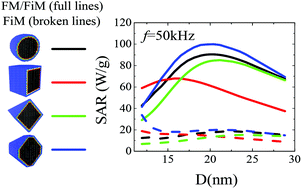
Hyperthermia in core/shell NP by Monte Carlo

Susceptibility losses in heating of magnetic core/shell nanoparticles for hyperthermia: a Monte Carlo study of shape and size effects.

M. Vasilakaki, C. Binns and K. N. Trohidou

Nanoscale 7, 7753 (2015)


Antiferromagnetic-Core/Ferrimagnetic-Shell NP

Enhanced Magnetic Properties in Antiferromagnetic-Core/Ferrimagnetic-Shell Nanoparticles.

Marianna Vasilakaki, Kalliopi N. Trohidou, Josep Nogués

Scientific Reports 5, 9609 (2015) 

(left) Schematic representation of the inverse AFM/FiM core/shell structure and (right) hysteresis loops of the doubly inverted nanoparticles, for different AFM core sizes (Dcore) and constant FiM shell thickness of four lattice spacings.

Tuesday, 21 April 2015

Control of NP Arrangement for Magnetic Hyperthermia

Nano-objects for Addressing the Control of Nanoparticle Arrangement and Performance in Magnetic Hyperthermia.Irene Andreu, Eva Natividad, Laura Solozábal, and Olivier Roubeau
ACS Nano 9, 1408 (2015)
One current challenge of magnetic hyperthermia is achieving therapeutic effects with a minimal amount of nanoparticles, for which improved heating abilities are continuously pursued. However, it is demonstrated here that the performance of magnetite nanocubes in a colloidal solution is reduced by 84% when they are densely packed in three-dimensional arrangements similar to those found in cell vesicles after nanoparticle internalization. This result highlights the essential role played by the nanoparticle arrangement in heating performance, uncontrolled in applications. A strategy based on the elaboration of nano-objects able to confine nanocubes in a fixed arrangement is thus considered here to improve the level of control. The obtained specific absorption rate results show that nanoworms and nanospheres with fixed one- and two-dimensional nanocube arrangements, respectively, succeed in reducing the loss of heating power upon agglomeration, suggesting a change in the kind of nano-object to be used in magnetic hyperthermia.

Scaling approach to MC simulations of magnetic models

Bridging the gap between discrete and continuous magnetic models in the scaling approach. E. A. Velásquez, J. Mazo-Zuluaga, P. Vargas, and J. Mejía-López
Phys. Rev. B 91, 134418 (2015)
Collapsed phase diagram for different scaling λ values. The inset shows the phase diagram for some selected scaling values, i.e., before the scaling up process.


Friday, 10 April 2015

Design of compensated ferrimagnetic Heusler alloys for giant tunable exchange bias : Nature Materials : Nature Publishing Group

Design of compensated ferrimagnetic Heusler alloys for giant tunable exchange bias.
Ajaya K. Nayak, Michael Nicklas, Stanislav Chadov, Panchanana Khuntia, Chandra Shekhar, Adel Kalache, Michael Baenitz, Yurii Skourski, Veerendra K. Guduru, Alessandro Puri, Uli Zeitler, J. M. D. Coey, Claudia Felser
Nature Materials 14, 679 (2015) 
a, Uncompensated magnetization, M, in Mn3−xPtxGa going through a compensation point (M = 0) at x = 0.59 (upper panel): squares are results from theoretical calculations. The line is a guide to eye. Lower panel: Experimental EB field HEB at 4.2 K (solid circles). The solid line corresponds to the result of our calculation. The regular and inverse Heusler structures of the Mn3Ga and Mn2PtGa are shown to the left and right respectively. b–d, Magnetic moments of Mn in two different sublattices for Mn3Ga, Mn2.41Pt0.59Ga and Mn2PtGa. Red arrows correspond to Mn in the Mn–Ga plane and blue arrows to Mn in the Mn–Mn planes. The size and direction of the moment is indicated by the arrow. Perfect magnetic compensation is expected in Mn2.41Pt0.59Ga. e, FM domains (boundaries indicated by dashed lines) inside the compensated AFM host.

Tuesday, 7 April 2015

Magnetoelastic coupling from first principles

General microscopic model of magnetoelastic coupling from first principles.
X. Z. Lu, Xifan Wu, and H. J. Xiang
Phys. Rev. B 91, 100405(R) (2015)


Nanocrystal Superlattices induced by magnetic forces

Beyond Entropy: Magnetic Forces Induce Formation of Quasicrystalline Structure in Binary Nanocrystal Superlattices.
Zhijie Yang, Jingjing Wei, Pierre Bonville, and Marie-Paule Pileni
JACS 137, 4487 (2015)  
Here, it is shown that binary superlattices of Co/Ag nanocrystals with the same size, surface coating, differing by their type of crystallinity are governed by Co–Co magnetic interactions. By using 9 nm amorphous-phase Co nanocrystals and 4 nm polycrystalline Ag nanocrystals at 25 °C, triangle-shaped NaCl-type binary nanocrystal superlattices are produced driven by the entropic force, maximizing the packing density. By contrast, using ferromagnetic 9 nm single domain (hcp) Co nanocrystals instead of amorphous-phase Co, dodecagonal quasicrystalline order is obtained

Autoresonant switching of NPs

Autoresonant switching of the magnetization in single-domain nanoparticles: Two-level theory.
Guillaume Klughertz, Lazar Friedland, Paul-Antoine Hervieux and Giovanni Manfredi

Phys. Rev. B 91, 104433 (2015)
Amplitude of the |A2|2 level in the two-parameter space (ε,a1−0.5), obtained from numerical solutions of Eqs. (14) and (15). Regions where |A2|2 is larger are those of efficient population transfer (i.e., efficient magnetization switching).


Low-energy excitations in geometrically frustrated magnets

Evidence for unidimensional low-energy excitations as the origin of persistent spin dynamics in geometrically frustrated magnets.
A. Yaouanc, P. Dalmas de Réotier, A. Bertin, C. Marin, E. Lhotel, A. Amato, and C. Baines

Phys. Rev. B 91, 104427 (2015)

(a) Rare-earth ions lattice in the pyrochlore R2M2O7 and normal spinel CdR2X4 compounds. The thicker light blue (thinner dark blue) bold line represents a 6 (10)-site loop. (b) Low-temperature heat capacity of CdHo2S4.

Wednesday, 25 March 2015

Target skyrmion switching by current

Switching of a target skyrmion by a spin-polarized current. 
Yan Liu, Haifeng Du, Min Jia, and An Du 

Phys. Rev. B 91, 094425 (2015)

Topography of mz during the skyrmion polarity switching process. The insets on the lower right show mz in the disk plane. The insets on the upper right display the cutlines along the diameter through the disk center. (i) Variation of the Rs with simulation time.


Wednesday, 18 March 2015

Dynamics of AF nanoparticles

Dynamic rotor mode in antiferromagnetic nanoparticles.
K. Lefmann, H. Jacobsen, J. Garde, P. Hedegård, A. Wischnewski, S. N. Ancona, H. S. Jacobsen, C. R. H. Bahl, and L. Theil Kuhn
Phys. Rev. B 91, 094421 (2015)

Illustration of two magnetic modes in an antiferromagnetic nanoparticle with a vertical easy axis. The A (B) sublattice points in the +z(−z) direction and describes a blue (red) trajectory: (top) a uniform in-plane magnetic mode; the ωα mode; (bottom) the “rotor mode.”

Friday, 13 March 2015

Nanoparticles for Imaging, Sensing, and Therapeutic Intervention: Review

 Nanoparticles for Imaging, Sensing, and Therapeutic Intervention.
Lara K. Bogart, Genevieve Pourroy, Catherine J. Murphy , Victor Puntes, Teresa Pellegrino, Daniel Rosenblum, Dan Peer, and Raphaël Lévy 

Nanomagnetic Colloidal Suspensions: Review

Nanomagnetic Colloidal Suspensions: An overview.
Donya Ramimoghadam, Samira Bagheri, Sharifah Bee Abd Hamid
Colloids and Surfaces B 133, 388 (2015)


Manipulating Topological States

Manipulating Topological States by Imprinting Non-Collinear Spin Textures.
Robert Streubel, Luyang Han, Mi-Young Im, Florian Kronast, Ulrich K. Rößler, Florin Radu, Radu Abrudan, Gungun Lin, Oliver G. Schmidt, Peter Fischer, Denys Makarov 
Scientific Reports 5, 8787 (2015)

Imprinting non-collinear magnetic spin textures into out-of-plane magnetised films (Co/Pd multilayers) via interlayer coupling to a vortex state (Permalloy, Py) (a). Calculations are carried out for a Co/Pd anisotropy of Ku = 200 kJ/m3. Depending on the interlayer exchange coupling strength and the magnetic field treatment (remanence or relaxed state), configurations of distinct topology can be imprinted in the out-of-plane magnetised layer as revealed by micromagnetic simulations. Figures (b)–(e) show the magnetic configuration of four different states in Co/Pd films with decreasing strength of interlayer coupling Ji (left to right) after applying an out-of-plane magnetic field. Colours correspond to the normalised out-of-plane magnetisation component: (b) Remanent and relaxed vortex state; (c)–(d) remanent donut state type II and type I (number of domain walls), respectively; and (e) relaxed magnetic spiral. The skyrmion number S of each state is assessed based on the sketched magnetisation configuration in the cross-section. (f) Line profiles through the center of the Co/Pd film for the normalised out-of-plane magnetisation (mz = Mz/Ms) in remanent state Co/Pd spins illustrate the possibility to tailor the opening angle of the donut state by adjusting Ji. The magnetic spiral also appears after opening the circular domain wall of the donut state by applying a small in-plane magnetic field.


Thursday, 12 March 2015

Control of spins of Co atoms

Controlling the Spin of Co Atoms on Pt(111) by Hydrogen Adsorption.
Q. Dubout, F. Donati, C. Wäckerlin, F. Calleja, M. Etzkorn, A. Lehnert, L. Claude, P. Gambardella, and H. Brune
Phys. Rev. Lett. 114, 106807 (2015)
Cobalt atoms exposed to hydrogen gas have higher spins, an effect that could be used to build magnetic nanostructures and lattices.


SG behavior in dilute dipolar Ising system

Low-temperature spin-glass behavior in a diluted dipolar Ising system.

Juan J. Alonso

Phys. Rev. B 91, 094406 (2015)

Semilog plots of q̃2(t0,t) and q2 vs time t (in MC sweeps) for DIS systems with concentration x=0.35 running at the lowest temperature Tn for the values of L indicated in the figure. T=0.075(T=0.05) for L=10(L=8).


Vortex state by electric measurements

Electrical determination of vortex state in submicron magnetic elements.
Ajay Gangwar, Hans G. Bauer, Jean-Yves Chauleau, Matthias Noske, Markus Weigand, Hermann Stoll, Gisela Schütz, and Christian H. Back 
AMR spectra measured on a disk shaped sample for (a) up (p=+1) and (b) down (p=−1) polarization of the vortex core for an excitation current of 1.2 mA. The sample design is shown in the inset of (a). By applying a rotating current (counterclockwise or clockwise) the VC polarity can be switched selectively to up or down. A sign change of the AMR voltage signal can be observed for the two polarities. Note that a significant shift of the resonance frequency to higher frequencies is observed at larger bias fields. Also note that the fine structure observed in the spectra does not depend on the VC polarity.

Wednesday, 11 March 2015

Prospects of Nanoscience with Nanocrystals.

Prospects of Nanoscience with Nanocrystals.
Maksym V. Kovalenko,*,†,‡ Liberato Manna,§,^ Andreu Cabot, Zeger Hens,#,4 Dmitri V. Talapin,2,3
Cherie R. Kagan,1,X Victor I. Klimov," Andrey L. Rogach,` Peter Reiss,¥ Delia J. Milliron,&
Philippe Guyot-Sionnnest,2 Gerasimos Konstantatos,x Wolfgang J. Parak,0,f Taeghwan Hyeon,9,O
Brian A. Korgel,&,b Christopher B. Murray,X and Wolfgang Heiss


http://pubs.acs.org/doi/pdfplus/10.1021/nn506223h