Showing posts with label Ab initio. Show all posts

Friday, 21 July 2017

Relativistic theory of magnetic inertia in ultrafast spin dynamics

Relativistic theory of magnetic inertia in ultrafast spin dynamics.
Ritwik Mondal, Marco Berritta, Ashis K. Nandy, and Peter M. Oppeneer
Phys. Rev. B 96, 024425 (2017)
Schematic illustration of magnetization dynamics. The precessional motion of M around Heff
 is depicted by the blue solid-dashed curve, and the nutation is shown by the red curve.

Monday, 18 April 2016

Geometrical Effects on the Magnetic Properties of NP

Geometrical Effects on the Magnetic Properties of  Nanoparticles.
Cono Di Paol, Roberto D’Agosta, and Francesca Baletto
Nano Letters 16, 2885 (2016)


Thursday, 4 June 2015

Atomistic spin dynamics: Review


Atomistic spin dynamics and surface magnons.
Corina Etz, Lars Bergqvist, Anders Bergman, Andrea Taroni and Olle Eriksson
Journal of Physics: Condensed Matter 27, 243202 
 Bridging the gap: the ASD link between ab initio methods and micromagnetics simulations.

Tuesday, 28 April 2015

Distribution of magnetic anisotropy in nanograins

Universal distribution of magnetic anisotropy of impurities in ordered and disordered nanograins
A. Szilva, P. Balla, O. Eriksson, G. Zaránd, and L. Szunyogh
Phys. Rev. B 91, 134421 (2015)
Radial distribution of the magnetic anisotropy parameters (dots) in the E plane in the case of NS=50 samples with N=225+25 atoms. The continuous line presents the predictions of the Gaussian orthogonal ensemble. Inset: Distribution of (K1,K2) in the E plane for these 50 nanograins. At this level of disorder the triangular structure is almost entirely lost.

Tuesday, 22 May 2012

DW in a Co nanocontact

Theoretical study of magnetic domain walls through a cobalt nanocontact.
Laszlo Balogh, Krisztian Palotas, Laszlo Udvardi, Laszlo Szunyogh, and Ulrich Nowak
Phys. Rev. B 86, 024406 (2012)
(a) The geometry of the contact viewed from the (110) direction. The leads are depicted as dark (blue) rectangles, the cobalt atoms forming the contact are represented by gray (orange) circles, and a denotes the nearest neighbor distance in
the fcc structure. (b) Sketch of the embedded cluster. Dark (blue) circles: selected atoms of the cobalt leads; gray (orange) circles: cobalt atoms in the nanocontact; empty circles: empty spheres around the contact.

Friday, 11 May 2012

Restoration of bulk magnetism in Fe oxide NPs by surfactant molecules

Surfactant Organic Molecules Restore Magnetism in Metal-Oxide Nanoparticle Surfaces.
Juan Salafranca, Jaume Gazquez, Nicolás Pérez, Amílcar Labarta, Sokrates T. Pantelides, Stephen J. Pennycook, Xavier Batlle, and Maria Varela
Nano Lett., 12, 2499 (2012)
Left: Density of states (DOS) projected over the majority spin d orbitals in the octahedral iron sites within different crystal environments. Organic acid bonded to magnetite surface. DOS projected over octahedral iron bonded to the organic acid. Because of the influence of the oxygen ions in the carboxylic group, occupancies are very similar to the bulk case, and the reduction of magnetization at the surface is partially lifted. Middle:  High-resolution Z-contrast STEM images of a Fe3O4 NP showing high crystal quality. Right: Top: L2,3 profile along the direction of the blue arrow in panel d (in red and in black for I+ and I− L23 ratio maps respectively). Bottom: difference between I+ and I− L2,3 ratios along the NP. The scale bar represents 5 nm in all panels.   


Thursday, 8 March 2012

EB induced by biquadratic interface exchange coupling

Flipping magnetization induced by noncollinear ferromagnetic-antiferromagnetic exchange coupling.
B. Y. Wang, C. H. Chuang, S. S. Wong, J. J. Chiou, W. C. Lin, Y. L. Chan, D. H. Wei, and Minn-Tsong Lin
Phys. Rev. B 85, 094412 (2012)
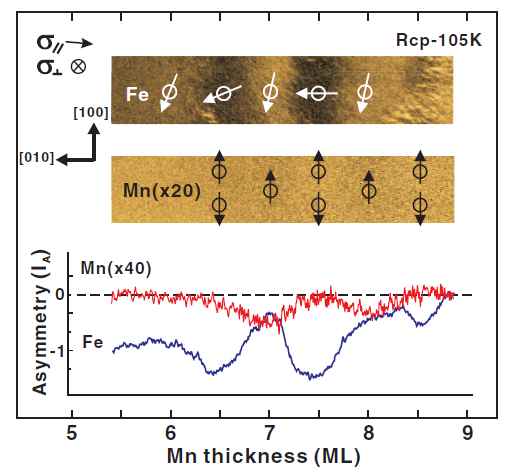
The Fe and Mn domain images as functions of tMn, taken at 105 K, at the region where the Fe film reveals the flipping magnetization (indicated by white arrows). The Mn layer yields nonvanishing IA at integer layer thickness and
approaches to zero value at half-integer layer thickness. A very small IA signal for the Mn layer could be attributed to a nearly orthogonal included angle between the photohelicity and in-plane magnetization.

Tuesday, 28 February 2012

Fe magnetic moment a MgO interface

Interfacial geometry dependence of the iron magnetic moment: The case of MgO/Fe/MgO.
Juan Ignacio Beltrán, Lluis Balcells, and Carlos Martínez-Boubeta
Phys. Rev. B 85, 064417 (2012)
Magnetic moment averaged per Fe atom from SQUID measurements (black circles), together with theoretical calculations of MgO/Fe/MgO structures with symmetric Fe-O bonding (green diamonds), and asymmetric coordination (blue triangles), as a function of the Fe thickness. The experimental data are fitted to a phenomenological exponential decaying function (as
mm = mmbulk + mmsurface e[1−thickness]/k, with the characteristic decay length k = 6 ML), which converge at large coverage to bulk Fe values.

Friday, 24 February 2012

Wednesday, 15 February 2012

DW magnetoresistance contrinutions by multiscale simulations

Disentangling the Physical Contributions to the Electrical Resistance in Magnetic DomainWalls: A Multiscale Study.
K. M. Seemann, F. Garcia-Sanchez, F. Kronast, J. Miguel, A. Kákay, C. M. Schneider, and R. Hertel, F. Freimuth, Y. Mokrousov, and S. Blügel
Phys. Rev. Lett. 108, 077201 (2012)
XMCD photoelectron emission microscopy asymmetry images of L10-ordered FePd (a) and FePt (b) taken at the Fe
L3-absorption edge for the demagnetized domain state at room temperature and in zero magnetic field. The insets to the upper right corner show the result of micromagnetic simulations.

Thursday, 26 January 2012

Exchange bias in La oxide lattices from as initio

Exchange bias in LaNiO3–LaMnO3 superlattices.
Marta Gibert, Pavlo Zubko, Raoul Scherwitzl, Jorge Íñiguez and Jean-Marc Triscone
Nature Mater. 11, 195 (2012)
Magnetic loops and temperature dependence of exchange bias field.

Results of the first-principles calculations.

Friday, 13 January 2012

Exchange constants from first principles in CuO

First-principles study of magnetic interactions in cupric oxide.
Abdul-Muizz Pradipto, Rémi Maurice, Nathalie Guihéry, Coen de Graaf, and Ria Broer
Phys. Rev. B 85, 014409 (2012)
The unit cell of CuO and the two neighboring Cu-O layers in the ac planes. The light and dark gray balls represent oxygen and copper atoms, respectively. Top right: The clusters used in this wor

Pressure induced metallization of FeO

Experimental and Theoretical Evidence for Pressure-Induced Metallization in FeO with Rocksalt-Type Structure.
Kenji Ohta, R. E. Cohen, Kei Hirose, Kristjan Haule, Katsuya Shimizu, and Yasuo Ohishi 
Phys. Rev. Lett. 108, 026403 (2012)

See also the Physics Synopsis at:
http://physics.aps.org/synopsis-for/10.1103/PhysRevLett.108.026403

Phase diagram of FeO. Stabilities of rB1, insulating B1, and metallic B1 phases are represented by solid, gray solid
and open symbols, respectively. Circles, squares and triangles indicate each set of experiments (runs1–3). A metal-insulator
transition boundary shown as bold line is determined from present data, and linearly extrapolated to the melting condition
(broken bold line). The estimated uncertainty in location of the transition is shown by gray band.

Thursday, 12 January 2012

Chemical Reviews: Volume 112, Issue 1 (ACS Publications)

Special issue dedicated to Quantum Chemistry containig several articles on electronic structure calculation methods.
Chemical Reviews: Volume 112, Issue 1 (2012)

Tuesday, 10 January 2012

Magnetic structure from ab initio reversed MC

Empirical Magnetic Structure Solution of Frustrated Spin Systems.
Joseph A. M. Paddison and Andrew L. Goodwin
Phys. Rev. Lett. 108, 017204 (2012)
Summary of results for frustrated magnets. (a) Heisenberg pyrochlore antiferromagnet; (b) ‘‘hexagonal
spin cluster’’ spinel ZnCr2O4; (c) GGG; (d) hyperkagome Na4Ir3O8; (e) extended kagome YBaCo4O7; (f ) kagome XY system; (g) kagome Ising system. The left-hand column shows the RMC fit to simulated powder diffraction data (calculation
details given in Ref. [12]). Input data are shown in black, RMC fit in red, and difference (RMC data) in blue.

ab initio EB in ruthenate/manganite

Ab initio study of the intrinsic exchange bias at the SrRuO3/SrMnO3 interface
Shuai Dong,1,2 Qinfang Zhang,3,4,5 Seiji Yunoki,4,5,6 J.-M. Liu,2,7 and Elbio Dagotto

Phys. Rev. B 84, 224437 (2011)
Sketches of interfacial noncollinear spin configurations after the self-consistency calculation reaches convergence.
Here, the initial spins SMn’s are along the (100) direction while SRu’s are along (001).

Wednesday, 21 December 2011

First-principles calculation of the nonadiabatic spin transfer torque in Ni and Fe.
Keith Gilmore, Ion Garate, Allan H. MacDonald, and M. D. Stiles
Phys. Rev. B 84, 224412 (2011)
Spin-transfer torque parameter versus resistivity for several ratios (r = 0.5, 1.0, 2.0) of spin-dependent scattering rates for Ni. The top panel gives β, the middle panel β/α, and the bottom panel βσP/(ασ). The dashed vertical lines indicate
the approximate room-temperature resistivity.

Fe films with spins spiral states from ab initio

Thickness-dependent magnetic structure of ultrathin Fe/Ir(001) films: From spin-spiral states toward ferromagnetic order.
A. Deák and L. Szunyogh, B. Ujfalussy

Phys. Rev. B 84, 224413 (2011)
Ground-state spin configurations of the Fe monolayer with experimental layer relaxation (a) without and (b) with
biquadratic couplings.

Friday, 25 November 2011

Ab initio couplings in Fe

Magnetoelastic coupling in gamma-iron.
S. V. Okatov, Yu. N. Gornostyrev, A. I. Lichtenstein, M. I. Katsnelson
ArXiv 1111.4432 (2011)
The exchange parameter as a function of interatomic distance to the n-th neighbour Jn(Rn) for different c/a ratios.

TM oxides by ab initio DFT calculations

Magnon spectrum of transition-metal oxides: Calculations including long-range magnetic interactions using the LSDA + U method.
F. Essenberger, S. Sharma, J. K. Dewhurst, C. Bersier, F. Cricchio, L. Nordström, and E. K. U. Gross
Phys. Rev. B 84, 174425 (2011)
N´eel temperatures as a function of U for NiO, CoO, and MnO. The dashed lines denote the experimental values and the gray solid lines are Monte Carlo simulations.