Molecules at the Quantum–Classical Nanoparticle Interface: Giant Mn70 Single-Molecule Magnets of ∼4 nm Diameter.
Alina Vinslava, Anastasios J. Tasiopoulos, Wolfgang Wernsdorfer, Khalil A. Abboud, and George Christou
| Beating observed after the SW point. The red line shows the fidelity sf and the green, blue, and orange lines show ⟨sz⟩, ⟨sx⟩−1.5, and ⟨sy⟩−2.5, where the parameters are S=20, Hx=1, D=1, and v=0.08. |
 |
a, |ms sublevels of the ground state of the single-molecule-magnet [Fe4(L)2(dpm)6], as obtained from equation (1). Absorption of phonons allows the barrier to be thermically overcome (green arrows). W ± n indicate the transition probabilities between magnetic |m states induced by the absorption (+) or emission (−) of n
phonons. Quantum tunnelling happens between admixed levels (red
arrows), whereas hyperfine and dipolar interactions create energy
distributions (orange). Interaction with Dirac electrons increases the
tunnel splittings below |3 and |−3 (red areas, exaggerated for clarity). b, Temperature and frequency dependence of the imaginary component of the dynamic susceptibility (χ′′) in a magnetic field H = 1 kOe for [Fe4(L)2(dpm)6] (top) and hybrids with isolated molecules (bottom). Lines are simulations with the theory (see text for the theory). c, Temperature and frequency dependence of the real component of the dynamic susceptibility (χ′) in H = 0 for [Fe4(L)2(dpm)6] (top) and hybrids with isolated molecules (bottom). Lines are simulations with the theory (see text for the theory). |
 |
| Dependence of energy on J at K=J and Iz/Ix=2 for different values of α. The plot shows first-order quantum phase transition on α. |

 |
| Here we demonstrate that electrospray ion beam deposition facilitates grafting of intact Mn12 molecules on metal as well as ultrathin insulating surfaces enabling submolecular resolution imaging by scanning tunneling microscopy. Using scanning tunneling spectroscopy we detect spin excitations from the magnetic ground state of the molecule at an ultrathin boron nitride decoupling layer. Our results are supported by density functional theory based calculations and establish that individual Mn12 molecules retain their intrinsic spin on a well chosen solid support. |
 |
| Zeeman diagram for a spin S =6 multiplet with easy-axis anisotropy [D<0 in Eq. (1)] and H//z. All possible nonzero tunneling gaps for C3 symmetry are labeled according to the scheme discussed in the main text. The inset shows the HT dependence of the odd-n tunneling gaps. |
 |
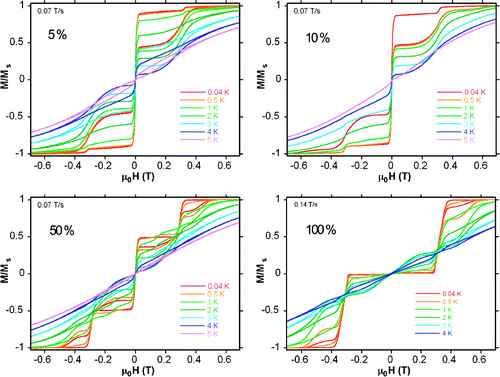
| Hysteresis loops in plots of magnetization vs dc field for a single crystal of 3·xCH2Cl2 (top) at the indicated temperatures at 0.28 T/s and (bottom) at the indicated field scan rates at 0.04 K. M is normalized to its saturation value, MS. |
 |
| Interface between normal and superconducting regions in a type-I superconductor, pinned by a planar defect in the XY plane. |
 |
| Temperature dependence of the magnetic viscosity S(T ) at H = 0 and 300 Oe. |
 |
| Quantum phase diagram for the ground-state magnetic moment and the total angular momentum. |