Showing posts with label Biomedical. Show all posts

Friday, 28 July 2017

Magneto-thermal capabilities of NP Review

Recent advances of magneto-thermal capabilities of nanoparticles: From design principles to biomedical applications.

Seung-hyun Noh, Seung Ho Moon, Tae-Hyun Shin, Yongjun Lim, Jinwoo Cheon
Nano Today 13, 61 (2017)


Friday, 30 June 2017

Surface design of magnetic nanoparticles for stimuli-responsive cancer imaging and therapy

Surface design of magnetic nanoparticles for stimuli-responsive cancer imaging and therapy
Taegyu Kang, Fangyuan Li, Seungmin Baik, Wei Shao, Daishun Ling, Taeghwan Hyeon
Biomaterials 136, 98 (2017)

Tuesday, 29 March 2016

NP for Cancer diagnosis and treatment: Review

Magnetite nanoparticles for cancer diagnosis, treatment, and treatment monitoring: recent advances.
  • Richard A. Revia, 
  • Miqin Zhang


  • Friday, 23 October 2015

    Review: Magnetic nanoparticles: applications in biomedicine

    Magnetic nanoparticles: material engineering and emerging applications in lithography and biomedicine.
    Yuping Bao, Tianlong Wen, Anna Cristina S. Samia, Amit Khandhar, Kannan M. Krishnan
    Journal of Materials Science 51, 513 (2016) 

    Thursday, 15 October 2015

    Iron Oxide NPs for Multimodal Imaging and Magnetoresponsive Therapy

    Iron Oxide Based Nanoparticles for Multimodal Imaging and Magnetoresponsive Therapy.
    Nohyun Lee, Dongwon Yoo, Daishun Ling, Mi Hyeon Cho, Taeghwan Hyeon, and Jinwoo Cheon 
    Chem. Rev. 115, 10637 (2015)
     

    Tuesday, 15 September 2015

    Photo-fluorescent and magnetic properties of iron oxide nanoparticles: Review

    Photo-fluorescent and magnetic properties of iron oxide nanoparticles for biomedical applications.
    Donglu Shi, M. E. Sadat, Andrew W. Dunna and David B. Mast
    Nanoscale 7, 8209 (2015)
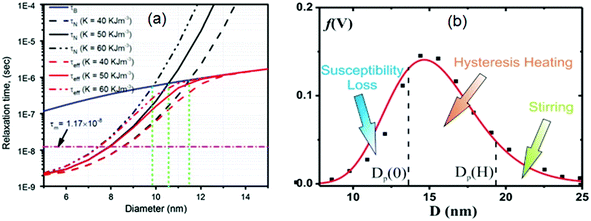
    (a) Graphical representation of Brownian, Néel and effective relaxation times as a function of particle diameter for different values of anisotropy constant (K)4 and (b) representation of heating due to Néel and Brownian relaxations, and hysteresis loss

    Recent Advances in Biomedical Imaging Agents

    Recent Advances in Higher-Order, Multimodal, Biomedical Imaging Agents.

    James Rieffel, Upendra Chitgupi andJonathan F. Lovell
    Small 11, 4445 (2015)

    Friday, 13 March 2015

    Nanoparticles for Imaging, Sensing, and Therapeutic Intervention: Review

     Nanoparticles for Imaging, Sensing, and Therapeutic Intervention.
    Lara K. Bogart, Genevieve Pourroy, Catherine J. Murphy , Victor Puntes, Teresa Pellegrino, Daniel Rosenblum, Dan Peer, and Raphaël Lévy 

    Monday, 23 February 2015

    Core/shell NPs for MRI and Tomography

    Multifunctional Fe3O4/TaOx Core/Shell Nanoparticles for Simultaneous Magnetic Resonance Imaging and X-ray Computed Tomography.
    Nohyun Lee, Hye Rim Cho, Myoung Hwan Oh, Soo Hong Lee, Kangmin Kim, Byung Hyo Kim, Kwangsoo Shin, Tae-Young Ahn, Jin Woo Choi, Young-Woon Kim, Seung Hong Choi, and Taeghwan Hyeon
    JACS 134, 10309 (2012)

    normal.img-000.jpg
    Schematic Illustration of Synthesis and Modification of Fe3O4/TaOx Core/Shell NPs

    Friday, 20 February 2015

    Tuesday, 18 December 2012

    Review of Iron oxide NPs for medical applications

    Chemical Design of Biocompatible Iron Oxide Nanoparticles for Medical Applications.
    Daishun Ling and Taeghwan Hyeon
    Small, ASAP (2012)

    Magnetic nanoparticles in biosciences: review

    Magnetic Nanoparticles and Biosciences
    Ivo Safaric and Mirka Safarikova
    Monatschefte Für Chemie 133, 737 (2002)
    Electron micrograph of a Magnetospirillum cell with magnetosomes arranged in a chain.

    Tuesday, 22 May 2012

    Wednesday, 11 April 2012

    Toxicity of SPIONs

    Assessing the In Vitro and In Vivo Toxicity of Superparamagnetic Iron Oxide Nanoparticles.
    Morteza Mahmoudi, Heinrich Hofmann, Barbara Rothen-Rutishauser,|and Alke Petri-Fink
    Chemical Reviews 112, 2323 (2012)
    (a) Prominent in vitro assays that are used to probe the impact of nanomaterials on cells; (b) TEM micrograph of a human
    liver cell line (HepG2) showing the mechanism of action of representative cell assays (i.e., MTT, checking mitochondria activity; PI, DNA staining; BrdU, DNA replication staining; LDH, membrane integrity assessment).

    Review of Core/Shell Nanoparticles

    A very complete review article focused on the synthesis, preparation methods, application and classification of all kind of core/shell NPs, not only magnetic:

    Core/Shell Nanoparticles: Classes, Properties, Synthesis Mechanisms, Characterization, and Applications
    Rajib Ghosh Chaudhuri and Santanu Paria
    Chemical Reviews 112, 2373 (2012)
    Different core/shell nanoparticles: (a) spherical core/shell NPs ; (b) hexagonal core/shell NPs; (c) multiple small core materials coated by single shell material; (d) nanomatryushka material; (e) movable core within hollow shell material.

    Friday, 30 March 2012

    Dipolar interactions of NP in cells

    Modeling magnetic nanoparticle dipole-dipole interactions inside living cells.
    Michael Lévy, Florence Gazeau, Jean-Claude Bacri, Claire Wilhelm, and Martin Devaud

    Phys. Rev. B 84, 075480 (2011)
    Model of spherical lysosome with a magnetization Mlys under an applied magnetic field B0. The Lorentz cavity around a particular (SP) NP (in dark) is displayed and the surface currents I and i on the surface of the lysosome and of the cavity, respectively, are also represented.
    Take a look also to the related articles by the same group:

    Nanomagnetism reveals the intracellular clustering of iron oxide nanoparticles in the organism.
    Michael Levy , Claire Wilhelm , Nathalie Luciani , Vanessa Deveaux , François Gendron , Alain Luciani , Martin Devaud and Florence Gazeau
    Nanoscale 3, 4402 (2011)

    Long term in vivo biotransformation of iron oxide nanoparticles.
    Michael Levy, Nathalie Luciani, Damien Alloyeau, Dan Elgrabli, Vanessa Deveaux, Christine Pechoux, Sophie Chat, Guillaume Wang, Nidhi Vats, François Gendron,Cécile Factor, Sophie Lotersztajn, Alain Luciani, Claire Wilhelm, Florence Gazeau
    Biomaterials 32, 3988 (2011)

    Wednesday, 28 March 2012

    Magnetic particle imaging

    X-Space MPI: Magnetic Nanoparticles for Safe Medical Imaging.
    Patrick William Goodwill, Emine Ulku Saritas, Laura Rose Croft,Tyson N. Kim, Kannan M. Krishnan, David V. Schaffer, Steven M. Conolly
    Advanced Materials Early view (2012)
    Magnetic particle imaging (MPI) is an emerging medical imaging technique that could be a safer alternative to X-ray and CT using iodinated contrast agents, especially for patients with chronic kidney disease. Here we describe the overall technique, detail the latest advances in MPI theory, and discuss the optimal nanoparticle characteristics for MPI. We also show images taken using our latest MPI hardware, demonstrating MPI's already superb contrast and high sensitivity.

    Monday, 12 March 2012

    Fe3O4–Au NPs for biomedical applications

    A Simple Approach to the Design and Functionalization of Fe3O4–Au Nanoparticles for Biomedical Applications.
    A. Narsi Reddy, K. Anjaneyulu, Dr. Pratyay Basak, Dr. N. Madhusudhana Rao and Dr. Sunkara V. Manorama
    ChemPlusChem ASAP (2012)
    A simple aqueous synthesis of a superparamagnetic and biofunctional nanocomposite system is described. Chitosan-stabilized Fe3O4 nanoparticles were synthesized at room temperature and the surface charge of these nanocomposites was exploited to prepare nanoparticles decorated with gold.
     

    Friday, 24 February 2012

    Improving biomedical applications of Fe oxide NPs

    Ultrasmall Iron Oxide Nanoparticles for Biomedical Applications: Improving the Colloidal and Magnetic Properties.
    Rocio Costo, Valentina Bello, Caroline Robic, Marc Port, Jose F. Marco, M. Puerto Morales, and
    Sabino Veintemillas-Verdaguer
    Langmuir 28, 178 (2012)
    A considerable increase in the saturation magnetization, Ms (40%), and initial susceptibility of ultrasmall (<5 nm) iron oxide nanoparticles prepared by laser pyrolysis was obtained through an optimized acid treatment. Moreover, a significant enhancement in the colloidal properties, such as smaller aggregate sizes in aqueous media and increased surface charge densities, was found after this chemical protocol. The results are consistent with a reduction in nanoparticle surface disorder induced by a dissolution–recrystallization mechanism.

    Thursday, 23 February 2012

    Biomedical Nanomagnetics: A Review

    Excellent review article dedicated to biomedical applications of nanoparticles. Kannan Krishnnan has been awarded a IEEE prize for the article: congratulations!

    Biomedical Nanomagnetics: A Spin Through Possibilities in Imaging, Diagnostics, and Therapy
    Kannan M. Krishnan
    IEEE Trans Magn. 46, 2523 (2010)