Showing posts with label Hollow. Show all posts

Friday, 28 July 2017

Influence of atomic lattice order on crystallinity of NP and their properties when a assembled

Impact of the Metallic Crystalline Structure on the Properties of Nanocrystals and Their Mesoscopic Assemblies.
Marie-Paule Pileni
Accounts of Chemical Research ASAP (2017)
The relation between structural atomic lattice and the degree of crystallinity of NP is nicely demonstrated here. Moreover, properties (mechanical, growth processes) of supracrystals also change with the nanocrystallinity of the nanoparticles used as building blocks.

Sunday, 13 December 2015

Spin-glass-like freezing of inner and outer surface layers in hollow γ-Fe2O3 nanoparticles

Spin-glass-like freezing of inner and outer surface layers in hollow γ-Fe2O3 nanoparticles.
Hafsa Khurshid, Paula Lampen-Kelley, Òscar Iglesias, Javier Alonso, Manh-Huong Phan, Cheng-Jun Sun, Marie-Louise Saboungi & Hariharan Srikanth
Snapshots of the outer and inner surface spin configurations subject to varying magnetic fields (a) h = 100 (the maximum positive applied field), (b) h = 0 (remanence at the upper branch), (c) h = −25 (near the negative coercive field), and (d) h = −100 (the maximum negative applied field). Spins have been colored with a gradient from dark-red/dark-blue (outer/inner surface) for spins along the field direction to yellow/green (outer/inner surface) for spins transverse to the field direction. Only a slice of the spin configurations of a hollow nanoparticle close to the central plane and perpendicular to the field direction is shown.

Friday, 18 September 2015

From core/shell to hollow Fe/γ-Fe2O3 NPs

From core/shell to hollow Fe/γ-Fe2O3 nanoparticles: evolution of the magnetic behavior.

Z Nemati, H Khurshid, J Alonso, M H Phan, P Mukherjee and H Srikanth

Nanotechnology 26, 405705 (2015)

Bright-field TEM images of the 12 nm Fe/γ-Fe2O3 (a) core/shell, (b) core/void/shell, and (c) hollow nanoparticles

Tuesday, 15 September 2015

Hollow magnetite NPs for Li storage

Formation of Uniform Fe3O4 Hollow Spheres Organized by Ultrathin Nanosheets and Their Excellent Lithium Storage Properties.
Fei-Xiang Ma, Han Hu, Hao Bin Wu, Cheng-Yan Xu, Zhichuan Xu, Liang Zhen and Xiong Wen (David) Lou

Monday, 23 February 2015

Surface and EB effects in core/shell and hollow NPs: compiliation

Impacts of surface spins and inter-particle interactions on the magnetism of hollow γ-Fe2O3 nanoparticles.
Hafsa Khurshid, Zohreh Nemati Porshokouh, Manh-Huong Phan, Pritish Mukherjee, and Hariharan Srikanth
J. Appl. Phys. 115, 17E131 (2014)
Temperature dependence of ZFC and FC magnetization taken in a field of 50 Oe for (a) 10 nm and (b) 15 nm hollow particles.
Tuning exchange bias in Fe/γ-Fe2O3 core-shell nanoparticles: Impacts of interface and surface spins.
Hafsa Khurshid, Manh-Huong Phan, Pritish Mukherjee, and Hariharan Srikanth
Temperature dependence of the net moment of frozen spins ( ) for (a) 15 nm, (b) 10 nm, and (c) 8 nm Fe/γ-Fe O nanoparticles. and are plotted as a function of particle size (d).
Mechanism and controlled growth of shape and size variant core/shell FeO/Fe3O4 nanoparticles.
Hafsa Khurshid, Wanfeng Li, Sayan Chandra, Manh-Huong Phan, George C. Hadjipanayis, Pritish Mukherjee and Hariharan Srikanth
Nanoscale 5, 7942 (2013) 
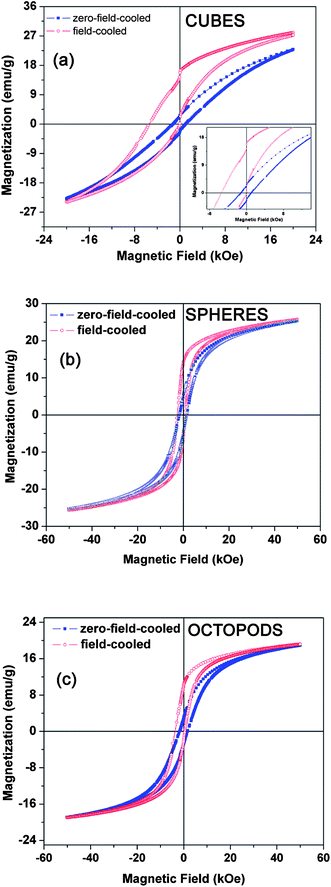
Hysteresis loops (M–H) measured in the ZFC and FC protocols for cubic, spherical, and octopod-shaped FeO/Fe3O4 nanoparticles. The inset of (a) shows an enlarged portion of the M–H curves featuring the low-field jump in the FC magnetization of the cubic nanoparticles. This feature is less pronounced in the case of the octopod-shaped nanoparticles (c) and is almost absent in the case of the spherical nanoparticles (b).
Asymmetric hysteresis loops and its dependence on magnetic anisotropy in exchange biased Co/CoO core-shell nanoparticles.
Sayan Chandra, Hafsa Khurshid, Manh-Huong Phan and Hariharan Srikanth
Appl. Phys. Lett. 101, 232405 (2012)
(a) Temperature dependence of exchange bias field for cooling field of 1 T and (b) temperature dependence of isothermal remanence. Insets in (a) show the ZFC and FC hysteresis loops at 10 K and 100 K. Inset in (b)shows the temperature dependence of blocking function distribution.
Surface spin disorder and exchange-bias in hollow maghemite nanoparticles.
Hafsa Khurshid, Wanfeng Li, Manh-Huong Phan, Pritish Mukherjee, George C. Hadjipanayis and Hariharan Srikanth
Appl. Phys. Lett. 101, 022403 (2012)
The FC ( ) loops taken at 5 K for (a) 9.2 nm and (b) 18.7 nm hollow nanoparticles. The TEM image of the 18.5 nm solid nanoparticles is shown in the inset of (b).

Tuesday, 28 May 2013

New route to nanocrystal synthesis: galvanic replacement

All change for nanocrystals.
Maria Ibáñez and Andreu Cabot
Science 340, 935 (2013)

Galvanic Replacement Reactions in Metal Oxide Nanocrystals.
Myoung Hwan Oh, Taekyung Yu, Seung-Ho Yu, Byungkwon Lim, Kyung-Tae Ko,Marc-Georg Willinger, Dong-Hwa Seo, Byung Hyo Kim, Min Gee Cho, Jae-Hoon Park, Kisuk Kang, Yung-Eun Sung, Nicola Pinna, Taeghwan Hyeon
Science 340, 964 (2013)

Schematic illustration of the transformation of Mn3O4 NCs, showing the evolution of their morphology via the localized dissolution of Mn3O4 and the surface precipitation of g-Fe2O3. (B to E) HRTEM images of the hollow nanostructures synthesized by the reaction of Mn3O4 NCs with 1 ml of aqueous solutions of iron(II) perchlorate having different concentrations.


Monday, 17 December 2012

Canted AFM in hollow nanospheres

Canted antiferromagnetism on a nanodimensional spherical surface geometry: The case of MnCO3 small hollow nanospheres.
Jin Bae Lee, Won G. Hong, Hae Jin Kim, Z. Jaglicic, S. Jazbec, M. Wencka, A. Jelen, and J. Dolinsek
(a) The M(H) curves of the HNSs sample and the MnCO3 bulk at T = 5 K for the magnetic field sweep ±50 kOe. The inset shows the hysteresis curves on an expanded scale around the H = 0 origin. (b) The M − χAFMH curves, by subtracting the linear (AFM-type) contribution from the measured magnetization data. Away from the hysteretic region, only the curves of the up-field run are shown. The inset shows the pure FM hysteresis loops MFM(H) on an expanded scale.

Monday, 16 April 2012

Hollow Iron Oxide Nanoparticles for Application in Lithium Ion Batteries - Nano Letters (ACS Publications)

Hollow Iron Oxide Nanoparticles for Application in Lithium Ion Batteries.Bonil Koo, Hui Xiong, Michael D. Slater, Vitali B. Prakapenka, Mahalingam Balasubramanian, Paul Podsiadlo, Christopher S. Johnson, Tijana Rajh, and Elena V. Shevchenko
Nano Lett.,12, 2429 (2012)
Amount of intercalated/deintercalated Li+ ions as a function of cycle numbers at different rates (a) with different individual electrodes.

Wednesday, 11 April 2012

Review of Core/Shell Nanoparticles

A very complete review article focused on the synthesis, preparation methods, application and classification of all kind of core/shell NPs, not only magnetic:

Core/Shell Nanoparticles: Classes, Properties, Synthesis Mechanisms, Characterization, and Applications
Rajib Ghosh Chaudhuri and Santanu Paria
Chemical Reviews 112, 2373 (2012)
Different core/shell nanoparticles: (a) spherical core/shell NPs ; (b) hexagonal core/shell NPs; (c) multiple small core materials coated by single shell material; (d) nanomatryushka material; (e) movable core within hollow shell material.

Thursday, 17 November 2011

Hollow inorganic spheres: A Review

Fabrication and application of inorganic hollow spheres.
Jing Hu, Min Chen, Xiaosheng Fang and Limin Wu
Chem. Soc. Rev. 40, 5472 (2011)


Tuesday, 5 July 2011

Hollow Fe oxide NPs

Chemically synthesized hollow nanostructures in iron oxides.
Hafsa Khurshid, Wanfeng Li, Vasillis Tzitzios and George C Hadjipanayis
Nanotechnology 22, 265605 (2011)