Showing posts with label Switching. Show all posts

Monday, 24 February 2020

Helicity control in magnetic nanotubes

Tailoring dual reversal modes by helicity control in ferromagnetic nanotubes.
H. D. Salinas, J. Restrepo, and Òscar Iglesias
Phys. Rev. B 101, 054419 (2020)
Magnetic configurations along the hysteresis loops for the different reversal modes displayed in Fig. 4 (left and right columns correspond to panels (a) and (c) of that figure). Upper panels represent the height profiles of the quantities ⟨θ⟩, ⟨mz⟩, and <mϕ⟩  averaged per layer for the tube (8,15) and γ= 0.035, whereas lower ones present snapshots of the spin configurations taken at points labeled in Fig. 4.

Thursday, 28 November 2019

The Heat in Antiferromagnetic Switching

The Heat in Antiferromagnetic Switching
Barry Zink
Physics 12, 134 (2019)

Absence of Evidence of Electrical Switching of the Antiferromagnetic Néel Vector
C. C. Chiang, S. Y. Huang, D. Qu, P. H. Wu, and C. L. Chien

Phys. Rev. Lett. 123, 227203 (2019)
Figure 1
Schematics of the eight-terminal patterned structure with the pulsed writing current along the 45° (write 1) and the 135° (write 2) lines for (a) planar Hall and (b) longitudinal resistance measurements. Relative changes of Hall resistance in (c) Pt/NiO/Si and (e) Pt/NiO/glass and relative change of longitudinal resistance in (d) Pt/NiO/Si and (f) Pt/NiO/glass, after applying 10-ms writing current pulses alternately along the 45° and the 135° lines.

Figure caption
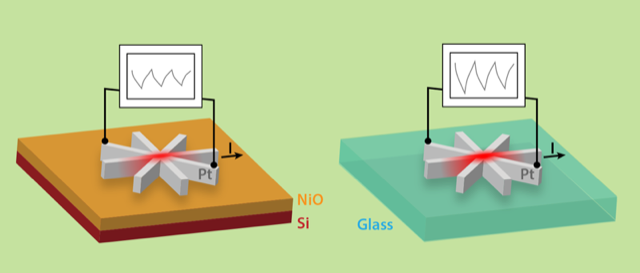
(Left) Platinum (Pt) strips grown on antiferromagnetic nickel oxide (NiO) films convert charge current to spin current, which is intended to switch the pointing direction of the insulating NiO’s spins. The switching is observed via a sawtooth voltage pattern. However, the Pt heats dramatically when the current is applied and (right) this heating reproduces the sawtooth pattern even when no antiferromagnet is present. 

Monday, 8 February 2016

High-frequency magnetization dynamics of individual atomic-scale magnets


High-frequency magnetization dynamics of individual atomic-scale magnets.

S. Krause, A. Sonntag, J. Hermenau, J. Friedlein, and R. Wiesendanger

Phys. Rev. B 93, 064407 (2016)
(a) Telegraphic noise z(t) on a nanomagnet at low and high I at closed feedback loop, and respective data histograms. (U=100 mV, T=45 K) (b) Top: Periodic sequence of high and low tunnel bias. Bottom: Resulting noise I on a thermally switching nanomagnet at constant tip-sample distance. (c) Averaged noise signal during one cycle, calculated from I(t) in (b).


Monday, 18 January 2016

Vortex core in a single NP

Switching the Magnetic Vortex Core in a Single Nanoparticle.
Elena Pinilla-Cienfuegos, Samuel Mañas-Valero, Alicia Forment-Aliaga, and Eugenio Coronado
ACS Nano 10, 1764 (2016)

Here we report the experimental observation of the vortex state formation and annihilation in individual 25 nm molecular-based magnetic nanoparticles measured by low-temperature variable-field magnetic force microscopy. Interestingly, in these nanoparticles the switching of the vortex core can be induced with very small values of the applied static magnetic field.

Friday, 30 October 2015

Switching of exchange coupled grains

Thermally activated switching at long time scales in exchange-coupled magnetic grains.

Ahmad M. Almudallal, J. I. Mercer, J. P. Whitehead, M. L. Plumer, J. van Ek, and T. J. Fal

Phys. Rev. B 92, 134418 (2015)

The contour plot of the minimum energy surface for the weak coupling case I=0.5×10⁻³J/m2 for (a) H=0 and (b) H=4kOe. The black lines indicate the boundary separating each pair of basins of attraction {Ωα,Ωβ} and is denoted by Γαβ. The red lines indicate the MEP connecting the four minima. The lines cross at the saddle points sαβ.


Tuesday, 7 April 2015

Autoresonant switching of NPs

Autoresonant switching of the magnetization in single-domain nanoparticles: Two-level theory.
Guillaume Klughertz, Lazar Friedland, Paul-Antoine Hervieux and Giovanni Manfredi

Phys. Rev. B 91, 104433 (2015)
Amplitude of the |A2|2 level in the two-parameter space (ε,a1−0.5), obtained from numerical solutions of Eqs. (14) and (15). Regions where |A2|2 is larger are those of efficient population transfer (i.e., efficient magnetization switching).


Wednesday, 11 March 2015

Switching of magnetic skyrmion cores in nanodots

Microwave-induced dynamic switching of magnetic skyrmion cores in nanodots.
Bin Zhang, Weiwei Wang, Marijan Beg, Hans Fangohr and Wolfgang Kuch

Appl. Phys. Lett. 106, 102401 (2015)

Spin dynamics of the skyrmion excited by an AC magnetic field hωz=hω sin(ωt) with hω=2.4×10⁻³ up to time 25 000 (∼16.5 ns for  = 1 meV and  = 1). Selected time evolution of the magnetization distribution with two examples: (a)  = 3.6 × 10−3, taoff=1750 and (b)  = 1.4 × 10−2, tboff=5600 . The color-coded (out-of-plane) and (in-plane) components of the magnetization are displayed in the first and third line, respectively, while the second line displays a perspective view (topography) with the color code of . (c) Time trace of the magnetization component (top graph), the AC magnetic field (dashed lines), and the skyrmion number (both in bottom graph). Black and red lines refer to the data of the two different examples, while the black circles and red prisms indicate the times corresponding to the snapshots shown in (a) and (b), respectively

Wednesday, 19 December 2012

Self assembly of magnetoferritin NPs

Hierarchical Self-Assembly and Optical Disassembly for Controlled Switching of Magnetoferritin Nanoparticle Magnetism.
Mauri A. Kostiainen,Pierpaolo Ceci,Manuela Fornara, Panu Hiekkataipale, Oksana Kasyutich, Roeland J. M. Nolte, Jeroen J. L. M. Cornelissen, Ryan D. Desautels, and Johan van Lierop
ACS Nano 5, 6394 (2011)


Abstract Image
Protein cages such as ferritin and viral capsids are interesting building blocks for nanotechnology due to their monodisperse structure and ability to encapsulate various functional moieties. Here we show that recombinant ferritin protein cages encapsulating Fe3O4–γ-Fe2O3 iron oxide (magnetoferritin) nanoparticles and photodegradable Newkome-type dendrons self-assemble into micrometer-sized complexes with a face-centered-cubic (fcc) superstructure and a lattice constant of 13.1 nm.

Monday, 7 May 2012

Spin torque

Spin-Torque Switching with the Giant Spin Hall Effect of Tantalum.
Luqiao Liu, Chi-Feng Pai, Y. Li, H. W. Tseng, D. C. Ralph, R. A. Buhrman
Science 336, 555 (2012)
ST-FMR induced by the spin Hall effect at room temperature. (A) Sample geometry for the ST-FMR measurement. IRF and HRF represent the applied radio frequency current and the corresponding Oersted field. Tau_h is the torque on the magnetization due to the Oersted field, and Tau_ST is the spin-transfer torque from the spin Hall effect. Resonant line shapes of the STFMR signals under a driving frequency f = 9 GHz for (B) CoFeB(4 nm)/Ta(8 nm) and (C) CoFeB(3 nm)/Pt
(6 nm). The squares represent experimental data, whereas the red curves are fits to a sum of symmetric and antisymmetric Lorentzians. From the ratio of the symmetric and antisymmeteric peak components in (C), we determine the JS/Je ratio for Pt to be ~0.07, consistent with earlier work (19). Vmix is the measured dc voltage due to the mixing of oscillating resistance and radio frequency current. The inset to (B) shows the dependence of the frequency f on the resonance magnetic field, in agreement with the Kittel formula (solid curve). (D) The resonance linewidth as determined from ST-FMR signals such as
those shown in (B) and (C) at different resonance frequencies. The Gilbert damping coefficients a for Ta and Pt are calculated from the linear fits to these linewidth data. CFB, CoFeB.

Saturday, 28 January 2012

Thermal switching of an anisotropic FM

Thermal switching rate of a ferromagnetic material with uniaxial anisotropy.
Tomohiro Taniguchi and Hiroshi Imamura
ArXiv 1201.5460 (2012)

The field h dependences of the normalized switchingrates, ˜r and rk. (a) ˜r (solid), r1 (dashed), and r2 (dotted,
inset) in the low field region. (b) ˜r, r1 (inset), and r2 in the high field region. (c), (d) ˜r, r1 (inset), and r3 in the low and
high field regions, respectively

Friday, 16 December 2011

Electric switching of magnets

Electric toggling of magnets.
Evgeny Y. Tsymbal
Nature Mater. 11, 3205 (2012)
Electric-field-induced toggle switching of magnetization. a, Schematic of the experiment performed by Wang and colleagues.

Tuesday, 5 July 2011

Ultrafast switching in AF MRAM

Ultrafast switching in a synthetic antiferromagnetic magnetic random-access memory device.
Anders Bergman, Björn Skubic, Johan Hellsvik, Lars Nordström, Anna Delin, and Olle Eriksson
Phys. Rev. B 83, 224429 (2011)
A switching diagram for the Fe3/Cr4/Fe3 system as a function of temperature. The phase diagram shows the z component of the average magnetization of one Fe layer color coded. The red/blue (light grey/dark grey) coloring indicates areas where switching has occurred/has not occurred.

Thursday, 30 June 2011

Switching nanomagnet with stress

Switching dynamics of a magnetostrictive single-domain nanomagnet subjected to stress.
Kuntal Roy, Supriyo Bandyopadhyay, and Jayasimha Atulasimha
Phys. Rev. B 83, 224412 (2011)

Wednesday, 27 April 2011

Switching NPs by microwaves

Optimal switching of a nanomagnet assisted by microwaves.
N. Barros, M. Rassam, H. Jirari, and H. Kachkachi
Phys Rev. B 83, 144418 (2011)
Optimized MWfield (upper panel) and the corresponding spin trajectories (lower panel). The inset is a 3D plot
of the spin trajectory on the unit sphere.