Showing posts with label Core/Shell. Show all posts

Tuesday, 24 December 2019

Exchange-bias feature in core-shell nanoparticles

On the first evidence of exchange-bias feature in magnetically contrasted consolidates made from CoFe 2 O 4 -CoO core-shell nanoparticles.
Nancy Flores-Martinez, Giulia Franceschin, Thomas Gaudisson, Sonia Haj-Khlifa, Sarra Gam Derouich, Nader Yaacoub, Jean-Marc Grenèche, Nicolas Menguy, Raul Valenzuela & Souad Ammar
Scientific Reports 9, 19468 (2019)
figure4
Thermal variation of the saturation and remanent magnetizations (a) and that of the coercive and exchange magnetic fields (b) of CFO-CO ceramic, as inferred from its FC hysteresis loops (cooling field of 7 T) recorded at different temperatures.

Friday, 28 July 2017

Tuning EB by control of interface coupling

Tuning the coercivity and exchange bias by controlling the interface coupling in bimagnetic core/shell nanoparticles.
Gabriel C. Lavorato, Enio Lima, Jr., Horacio E. Troiani, Roberto D. Zysler and Elin L. Winkler
Nanoscale 9, 10240 (2017)


Influence of atomic lattice order on crystallinity of NP and their properties when a assembled

Impact of the Metallic Crystalline Structure on the Properties of Nanocrystals and Their Mesoscopic Assemblies.
Marie-Paule Pileni
Accounts of Chemical Research ASAP (2017)
The relation between structural atomic lattice and the degree of crystallinity of NP is nicely demonstrated here. Moreover, properties (mechanical, growth processes) of supracrystals also change with the nanocrystallinity of the nanoparticles used as building blocks.

Monday, 2 May 2016

Mean-field and linear regime approach to magnetic hyperthermia of core–shell nanoparticles: can tiny nanostructures fight cancer? - Nanoscale (RSC Publishing)

Mean-field and linear regime approach to magnetic hyperthermia of core–shell nanoparticles: can tiny nanostructures fight cancer?
Marcus S. Carriao and Andris F. Bakuzis
Nanoscale 8, 8363 (2016)
The phenomenon of heat dissipation by magnetic materials interacting with an alternating magnetic field, known as magnetic hyperthermia, is an emergent and promising therapy for many diseases, mainly cancer. Here, a magnetic hyperthermia model for core–shell nanoparticles is developed. The theoretical calculation, different from previous models, highlights the importance of heterogeneity by identifying the role of surface and core spins on nanoparticle heat generation. We found that the most efficient nanoparticles should be obtained by selecting materials to reduce the surface to core damping factor ratio, increasing the interface exchange parameter and tuning the surface to core anisotropy ratio for each material combination. From our results we propose a novel heat-based hyperthermia strategy with the focus on improving the heating efficiency of small sized nanoparticles instead of larger ones. This approach might have important implications for cancer treatment and could help improving clinical efficacy.
 

Thursday, 3 March 2016

Disentangling magnetic core/shell morphologies in Co-based nanoparticles - Journal of Materials Chemistry C (RSC Publishing)

Disentangling magnetic core/shell morphologies in Co-based nanoparticles.
Natalia Rinaldi-Montes, Pedro Gorria, David Martínez-Blanco, Zakariae Amghouz, Antonio B. Fuertes, Luis Fernández Barquín, Jesús Rodríguez Fernández, Luca Olivi, Giuliana Aquilanti and Jesús A. Blanco

Friday, 18 September 2015

From core/shell to hollow Fe/γ-Fe2O3 NPs

From core/shell to hollow Fe/γ-Fe2O3 nanoparticles: evolution of the magnetic behavior.

Z Nemati, H Khurshid, J Alonso, M H Phan, P Mukherjee and H Srikanth

Nanotechnology 26, 405705 (2015)

Bright-field TEM images of the 12 nm Fe/γ-Fe2O3 (a) core/shell, (b) core/void/shell, and (c) hollow nanoparticles

Monday, 20 July 2015

Magnetic Interactions and Energy Barrier Enhancement in Core/Shell Bimagnetic Nanoparticles - The Journal of Physical Chemistry C (ACS Publications)


Magnetic Interactions and Energy Barrier Enhancement in Core/Shell Bimagnetic Nanoparticles.
Gabriel C. Lavorato, Davide Peddis, Enio Lima , Jr., Horacio E. Troiani, Elisabetta Agostinelli, Dino Fiorani, Roberto D. Zysler, and Elin L. Winkler
J. Phys. Chem. C 119, 15755 (2015) 
In this work, we studied the dynamic and static magnetic properties of ZnO-core/CoFe2O4-shell and CoO-core/CoFe2O4-shell nanoparticles. Both systems are formed by a core of ∼4 nm of diameter encapsulated in a shell of ∼2 nm of thickness. The mean blocking temperature changes from 106(7) to 276(5) K when the core is diamagnetic or antiferromagnetic, respectively. Magnetic remanence studies revealed the presence of weak dipolar interparticle interactions, where Hint is approximately −0.1 kOe for ZnO/CoFe2O4 and −0.9 kOe for CoO/CoFe2O4, playing a minor role in the magnetic behavior of the materials. Relaxation experiments provided evidence that the magnetization reversal process of CoFe2O4 is strongly dependent on the magnetic order of the core. At 10 K, activation volumes of ∼46(6) and ∼69(5) nm3 were found for CoO/CoFe2O4 and ZnO/CoFe2O4 nanoparticles, respectively, corresponding to one-third and one-fifth of the total shell volume. While the magnetic behavior of ZnO/CoFe2O4 nanoparticles is strongly affected by the surface disorder, the exchange coupling at the CoO/CoFe2O4 interface rules the magnetization reversal and the nanoparticles’ thermal stability by inducing a larger energy barrier and promoting smaller switching volume.

Friday, 24 April 2015

Hyperthermia in core/shell NP by Monte Carlo

Susceptibility losses in heating of magnetic core/shell nanoparticles for hyperthermia: a Monte Carlo study of shape and size effects.

M. Vasilakaki, C. Binns and K. N. Trohidou

Nanoscale 7, 7753 (2015)


Antiferromagnetic-Core/Ferrimagnetic-Shell NP

Enhanced Magnetic Properties in Antiferromagnetic-Core/Ferrimagnetic-Shell Nanoparticles.

Marianna Vasilakaki, Kalliopi N. Trohidou, Josep Nogués

Scientific Reports 5, 9609 (2015) 

(left) Schematic representation of the inverse AFM/FiM core/shell structure and (right) hysteresis loops of the doubly inverted nanoparticles, for different AFM core sizes (Dcore) and constant FiM shell thickness of four lattice spacings.

Wednesday, 11 March 2015

FM at the interface of AF Co oxide NanoOctahedra NP, Room T magnetism and EB

Electrostatic doping as a source for robust ferromagnetism at the interface between antiferromagnetic cobalt oxides.
Zi-An Li, N. Fontaíña-Troitiño, A. Kovács, S. Liébana-Viñas, M. Spasova, R. E. Dunin-Borkowski, M. Müller, D. Doennig, R. Pentcheva, M. Farle & V. Salgueiriño 
(a) Size dependence of experimentally measured (black solid (T = 5 K) and dashed (300 K) lines) and calculated saturation magnetization MS of CoO octahedra. A magnetic moment μ of (4.8 ± 0.4)μB per Co2+ ion and a shell thickness of 3 nm Co3O4 is assumed. MS arises only from the Co cations at the surfaces or interfaces of the octahedral nanocrystals, as indicated in the schematic in (b). The blue lines are calculated values assuming only effectively one layer of Co2+ cations at the Co3O4 surface, while the red lines correspond to a double layer of Co cations at the interface.
Room-Temperature Ferromagnetism in Antiferromagnetic Cobalt Oxide Nanooctahedra.  
N. Fontaíña-Troitiño, S. Liébana-Viñas, Benito Rodríguez-González, Zi-An Li, M. Spasova, M. Farle, V. Salgueiriño
Nano Lett..14, 640 (2014)
Cobalt oxide octahedra were synthesized by thermal decomposition. Each octahedron-shaped nanoparticle consists of an antiferromagnetic CoO core enclosed by eight {111} facets interfaced to a thin (∼4 nm) surface layer of strained Co3O4. The nearly perfectly octahedral shaped particles with 20, 40, and 85 nm edge length show a weak room-temperature ferromagnetism that can be attributed to ferromagnetic correlations appearing due to strained lattice configurations at the CoO/Co3O4 interface.

Exchange Bias Effect in CoO@Fe3O4 Core−Shell Octahedron-Shaped Nanoparticles.  
Nerio Fontaíña Troitiño, Beatriz Rivas-Murias, Benito Rodríguez-González, and Verónica Salgueiriño
Chem. Mater. 26, 5566 (2014)
Increased coercive and tunable exchange bias field values were registered in hybrid CoO@Fe3O4 core–shell octahedron-shaped nanoparticles of different average size. In this strained morphology, the metal cation chemical potentials at the interface between the antiferromagnetic and ferrimagnetic oxides become a very dynamic variable. This causes the effective magnetic anisotropy to increase and the type of interface to change after growing the magnetite shell epitaxially onto the cobalt oxide {111} surface facets and, consequently, to tune the exchange bias effect.


Monday, 23 February 2015

Tuning shape, exchange and surface anisotropy of core/shell NPs

Nanoscale Magnetism Control via Surface and Exchange Anisotropy for Optimized Ferrimagnetic Hysteresis.
Seung-hyun Noh, Wonjun Na, Jung-tak Jang, Jae-Hyun Lee, Eun Jung Lee, Seung Ho Moon,
Yongjun Lim, Jeon-Soo Shin, and Jinwoo Cheon

Nano Letters 12, 3716 (2012)
normal.img-001.jpg
Morphological and structural evolution of magnetic nanoparticle and correlated tunability of nanomagnetism. (a) Magnetic NPs with various structural motifs exhibiting differences in size, surface anisotropy, and exchange anisotropy. (b) Magnetism tuning by the systematicchanges of magnetic nanoparticles. Graphs i−iv correspond to the nanoparticles shown in part a where modulation of structural motifs is needed to control parameters such as K, Hc, Ms, or Mr.


Images and magnetization behaviors of cube and sphere nanoparticles. (a) TEM images of cube (18 nm (σ ≈ 5%) in edge length) and (b) sphere nanoparticle (22 nm (σ ≈ 7%) in diameter). Nanoparticles have identical composition (Zn0.4Fe2.6O4) and magnetic volume (5.8 × 10⁻²⁴ m3). (c) High resolution TEM image of cube exhibiting well-defined lattice fringes of {100} faces. (d) M-H curves of cube and sphere measured at 300 K using SQUID. Ms of cube is 165 emu/g(Fe+Zn), and that of sphere is 145 emu/g(Fe+Zn). Simulated magnetic spin states of (e) cube and (f) sphere by using OOMMF program. The color map indicates the degree of spin canting against external magnetic field (B0) where red indicates nondeviated spins and blue indicates highly canted spins. Local spin states on the surfaces of nanoparticles are depicted on the right corners of parts e and f. Cube exhibits lower spin disorder rate of 4% than sphere of 8%.


Core/shell NPs for MRI and Tomography

Multifunctional Fe3O4/TaOx Core/Shell Nanoparticles for Simultaneous Magnetic Resonance Imaging and X-ray Computed Tomography.
Nohyun Lee, Hye Rim Cho, Myoung Hwan Oh, Soo Hong Lee, Kangmin Kim, Byung Hyo Kim, Kwangsoo Shin, Tae-Young Ahn, Jin Woo Choi, Young-Woon Kim, Seung Hong Choi, and Taeghwan Hyeon
JACS 134, 10309 (2012)

normal.img-000.jpg
Schematic Illustration of Synthesis and Modification of Fe3O4/TaOx Core/Shell NPs

Surface and EB effects in core/shell and hollow NPs: compiliation

Impacts of surface spins and inter-particle interactions on the magnetism of hollow γ-Fe2O3 nanoparticles.
Hafsa Khurshid, Zohreh Nemati Porshokouh, Manh-Huong Phan, Pritish Mukherjee, and Hariharan Srikanth
J. Appl. Phys. 115, 17E131 (2014)
Temperature dependence of ZFC and FC magnetization taken in a field of 50 Oe for (a) 10 nm and (b) 15 nm hollow particles.
Tuning exchange bias in Fe/γ-Fe2O3 core-shell nanoparticles: Impacts of interface and surface spins.
Hafsa Khurshid, Manh-Huong Phan, Pritish Mukherjee, and Hariharan Srikanth
Temperature dependence of the net moment of frozen spins ( ) for (a) 15 nm, (b) 10 nm, and (c) 8 nm Fe/γ-Fe O nanoparticles. and are plotted as a function of particle size (d).
Mechanism and controlled growth of shape and size variant core/shell FeO/Fe3O4 nanoparticles.
Hafsa Khurshid, Wanfeng Li, Sayan Chandra, Manh-Huong Phan, George C. Hadjipanayis, Pritish Mukherjee and Hariharan Srikanth
Nanoscale 5, 7942 (2013) 
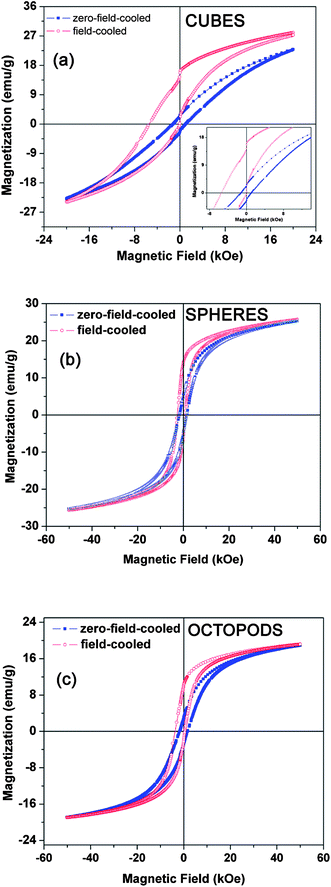
Hysteresis loops (M–H) measured in the ZFC and FC protocols for cubic, spherical, and octopod-shaped FeO/Fe3O4 nanoparticles. The inset of (a) shows an enlarged portion of the M–H curves featuring the low-field jump in the FC magnetization of the cubic nanoparticles. This feature is less pronounced in the case of the octopod-shaped nanoparticles (c) and is almost absent in the case of the spherical nanoparticles (b).
Asymmetric hysteresis loops and its dependence on magnetic anisotropy in exchange biased Co/CoO core-shell nanoparticles.
Sayan Chandra, Hafsa Khurshid, Manh-Huong Phan and Hariharan Srikanth
Appl. Phys. Lett. 101, 232405 (2012)
(a) Temperature dependence of exchange bias field for cooling field of 1 T and (b) temperature dependence of isothermal remanence. Insets in (a) show the ZFC and FC hysteresis loops at 10 K and 100 K. Inset in (b)shows the temperature dependence of blocking function distribution.
Surface spin disorder and exchange-bias in hollow maghemite nanoparticles.
Hafsa Khurshid, Wanfeng Li, Manh-Huong Phan, Pritish Mukherjee, George C. Hadjipanayis and Hariharan Srikanth
Appl. Phys. Lett. 101, 022403 (2012)
The FC ( ) loops taken at 5 K for (a) 9.2 nm and (b) 18.7 nm hollow nanoparticles. The TEM image of the 18.5 nm solid nanoparticles is shown in the inset of (b).

Simulations of large arrays of Core/Shell NP

Mesoscopic Model for the Simulation of Large Arrays of Bi-Magnetic Core/Shell Nanoparticles.
G. Margaris, K. N. Trohidou, and J. Nogués
Advanced Materials 24, 4331 (2012)
A mesoscopic approach to simulate large arrays of core/shell nanoparticles based on the reduction of the number of simulated spins is presented. The model is used to simulate arrays of Co/CoO nanoparticles with different nanoparticle densities.

Interactions and size dependence in core/shell Fe NPs

Size Dependence of Inter- and Intracluster Interactions in Core−Shell Iron−Iron Oxide Nanoclusters.
Maninder Kaur, John S. McCloy, Weilin Jiang, Qi Yao, and You Qiang
J. Phys. Chem. C 116, 12875 (2012)

Sunday, 22 February 2015

Tuning EB in core shell NP by defects

1) Monte Carlo simulations of core/shell nanoparticles containing interfacial defects: Role of disordered ferromagnetic spins.
Le Bin Ho, Tran Nguyen Lan, Tran Hoang Hai
Physica B 430, 10 (2013)


2) Defect-tuning exchange bias of ferromagnet/antiferromagnet core/shell nanoparticles by numerical study.
Zhongquan Mao, Xiaozhi Zhan and Xi Chen

J. Phys.: Condens. Matter 24, 276002 (2012)

Thursday, 10 July 2014

Au@Co3O4 NP for catalysis

Synthesis of Monodispere Au@Co3O4 Core-Shell Nanocrystals and Their Enhanced Catalytic Activity for Oxygen Evolution Reaction.
Zhongbin Zhuang, Wenchao Sheng and Yushan Yan
Novel OER catalysts – monodisperse Au@Co3O4 core-shell nanocrystals – have been prepared by synthesizing Au nanocrystals, followed by deposition of Co shells and their conversion to Co3O4 shells. Owing to the synergistic effect, Au@Co3O4 nanocrystals have an OER activity 7 times as high as a Au and Co3O4 nanocrystals mixture or Co3O4 nanocrystals alone, and 55 times as high as Au nanocrystals alone

Tuesday, 28 May 2013

New route to nanocrystal synthesis: galvanic replacement

All change for nanocrystals.
Maria Ibáñez and Andreu Cabot
Science 340, 935 (2013)

Galvanic Replacement Reactions in Metal Oxide Nanocrystals.
Myoung Hwan Oh, Taekyung Yu, Seung-Ho Yu, Byungkwon Lim, Kyung-Tae Ko,Marc-Georg Willinger, Dong-Hwa Seo, Byung Hyo Kim, Min Gee Cho, Jae-Hoon Park, Kisuk Kang, Yung-Eun Sung, Nicola Pinna, Taeghwan Hyeon
Science 340, 964 (2013)

Schematic illustration of the transformation of Mn3O4 NCs, showing the evolution of their morphology via the localized dissolution of Mn3O4 and the surface precipitation of g-Fe2O3. (B to E) HRTEM images of the hollow nanostructures synthesized by the reaction of Mn3O4 NCs with 1 ml of aqueous solutions of iron(II) perchlorate having different concentrations.


Monday, 17 December 2012

Assymetric hysteresis loops in EB core/shell NPs

Asymmetric hysteresis loops and its dependence on magnetic anisotropy in exchange biased Co/CoO core-shell nanoparticles.
Sayan Chandra, Hafsa Khurshid, Manh-Huong Phan, and Hariharan Srikanth
Appl. Phys. Lett. 101, 232405 (2012)
(a) and (b) Bipolar TS scan at 20K and 130K under FC condition indicatingthe anisotropy fields and g, (c) temperature dependence of g, (d) temperature dependence of shift in the first anisotropy peaks in the bipolar scans.

Monday, 23 April 2012

EB in core/shell AFM/FM NPs

Modeling of exchange bias in the antiferromagnetic (core)/ferromagnetic (shell) nanoparticles with specialized shapes.
Yong Hu,  Yan Liu, An DuJMMM 323, 2613 (2012)
 Snapshots of the spin configurations in the vertical section central plane through the symmetry axis of ellipsoid-shaped nanoparticle with KC=0.5 in different fields around the coercive fields of field-cooled hysteresis loop. Hl and Hr are the fields around the coercive fields at the descending and ascending branches, respectively. (a) Hl=−0.07, (b) Hl=−0.08, (c) Hl=−0.09, (d) Hl=−0.10, (e) Hl=−0.11, (f) Hr=0.03, (g) Hr=0.05, (h) Hr=0.07, (i) Hr=0.08, (j) Hr=0.09.