Showing posts with label Fe Oxide. Show all posts

Friday, 30 June 2017

Thermal Decomposition Synthesis of Iron Oxide Nanoparticles with Diminished Magnetic Dead Layer by Controlled Addition of Oxygen - ACS Nano (ACS Publications)

Thermal Decomposition Synthesis of Iron Oxide Nanoparticles with Diminished Magnetic Dead Layer by Controlled Addition of Oxygen.
Mythreyi Unni,Amanda M. Uhl, Shehaab Savliwala, Benjamin H. Savitzky, Rohan Dhavalikar, Nicolas Garraud, David P Arnold, Lena F. Kourkoutis, Jennifer S. Andrew, and Carlos Rinaldi
Decades of research focused on size and shape control of iron oxide nanoparticles have led to methods of synthesis that afford excellent control over physical size and shape but comparatively poor control over magnetic properties. Popular synthesis methods based on thermal decomposition of organometallic precursors in the absence of oxygen have yielded particles with mixed iron oxide phases, crystal defects, and poorer than expected magnetic properties, including the existence of a thick “magnetically dead layer” experimentally evidenced by a magnetic diameter significantly smaller than the physical diameter. Here, we show how single-crystalline iron oxide nanoparticles with few defects and similar physical and magetic diameter distributions can be obtained by introducing molecular oxygen as one of the reactive species in the thermal decomposition synthesis. This is achieved without the need for any postsynthesis oxidation or thermal annealing. These results address a significant challenge in the synthesis of nanoparticles with predictable magnetic properties and could lead to advances in applications of magnetic nanoparticles.


Standardizing Size- and Shape-Controlled Synthesis of Monodisperse Magnetite (Fe3O4) Nanocrystals by Identifying and Exploiting Effects of Organic Impurities

Standardizing Size- and Shape-Controlled Synthesis of Monodisperse Magnetite Nanocrystals by Identifying and Exploiting Effects of Organic Impurities.
Liang Qiao, Zheng Fu, Ji Li, John Ghosen, Ming Zeng, John Stebbins, Paras N. Prasad, and Mark T. Swihart

Size-Dependent Heating of Magnetic Iron Oxide NP

Size-Dependent Heating of Magnetic Iron Oxide Nanoparticles.
Sheng Tong, Christopher A. Quinto, Linlin Zhang, Priya Mohindra, and Gang Bao

Friday, 25 September 2015

Neel and Brownian relaxation in NPs by ac field

Mixed Brownian alignment and Néel rotations in superparamagnetic iron oxide nanoparticle suspensions driven by an ac field.

Saqlain A. Shah, Daniel B. Reeves, R. Matthew Ferguson, John B. Weaver, and Kannan M. Krishnan
Phys. Rev. B 92, 094438 (2015)
Comparison between simulation and experiment for nanoparticles either in either a frozen or melted state. Spectroscopy was performed with a 26-kHz, 31 mT/μ0 field. The log-normal distributions of particle diameter and anisotropy constant are shown on the right by number in a representative 1000-particle subsample.
 

Tuesday, 15 September 2015

Photo-fluorescent and magnetic properties of iron oxide nanoparticles: Review

Photo-fluorescent and magnetic properties of iron oxide nanoparticles for biomedical applications.
Donglu Shi, M. E. Sadat, Andrew W. Dunna and David B. Mast
Nanoscale 7, 8209 (2015)
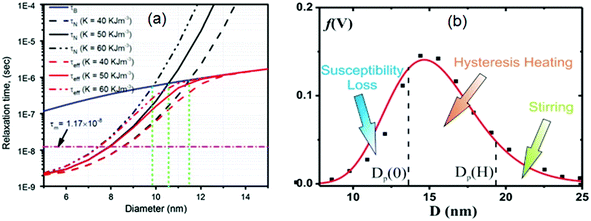
(a) Graphical representation of Brownian, Néel and effective relaxation times as a function of particle diameter for different values of anisotropy constant (K)4 and (b) representation of heating due to Néel and Brownian relaxations, and hysteresis loss

Saturday, 22 August 2015

Exchange bias in Au-Fe3O4 dumbbell NPs

Exchange bias effect in Au-Fe3O4 dumbbell nanoparticles induced by the charge transfer from gold.
Mikhail Feygenson, John C. Bauer, Zheng Gai, Carlos Marques, Meigan C. Aronson, Xiaowei Teng, Dong Su, Vesna Stanic, Volker S. Urban, Kevin A. Beyer, and Sheng Dai
Phys. Rev. B 92, 054416 (2015)
Temperature-dependent ZFC and FC magnetizations for (a) Au-4 sample and (b) free solution of Fe3O4 and Au nanoparticles. The field-dependent magnetization measured after field cooling in 50 kOe from 300 K for (c) Au-4 and (d) reference samples at various temperatures. Inset: the same plot at lower fields, showing no horizontal shift of the hysteresis loop.

Tuesday, 21 July 2015

Size dependent Verwey transition

Size Dependence of Metal–Insulator Transition in Stoichiometric Fe3O4 Nanocrystals.
Jisoo Lee, Soon Gu Kwon, Je-Geun Park, and Taeghwan Hyeon
Nano Lett. 15, 4337 (2015)
Size dependence of TV for Fe3O4 NCs. The contour plot represents the heat capacity data after removing the contribution of surfactant. The symbols mark the Verwey transition temperature (TV) determined from three different types of measurements: heat capacity (green, CP/T), conductance (blue, G), and magnetic moment (red, m). The size dependence of blocking temperature (TB) is also plotted from the same magnetization measurement (black). The gray line is a guide to the eye for the size dependence of TB.
 

Wednesday, 11 March 2015

FM at the interface of AF Co oxide NanoOctahedra NP, Room T magnetism and EB

Electrostatic doping as a source for robust ferromagnetism at the interface between antiferromagnetic cobalt oxides.
Zi-An Li, N. Fontaíña-Troitiño, A. Kovács, S. Liébana-Viñas, M. Spasova, R. E. Dunin-Borkowski, M. Müller, D. Doennig, R. Pentcheva, M. Farle & V. Salgueiriño 
(a) Size dependence of experimentally measured (black solid (T = 5 K) and dashed (300 K) lines) and calculated saturation magnetization MS of CoO octahedra. A magnetic moment μ of (4.8 ± 0.4)μB per Co2+ ion and a shell thickness of 3 nm Co3O4 is assumed. MS arises only from the Co cations at the surfaces or interfaces of the octahedral nanocrystals, as indicated in the schematic in (b). The blue lines are calculated values assuming only effectively one layer of Co2+ cations at the Co3O4 surface, while the red lines correspond to a double layer of Co cations at the interface.
Room-Temperature Ferromagnetism in Antiferromagnetic Cobalt Oxide Nanooctahedra.  
N. Fontaíña-Troitiño, S. Liébana-Viñas, Benito Rodríguez-González, Zi-An Li, M. Spasova, M. Farle, V. Salgueiriño
Nano Lett..14, 640 (2014)
Cobalt oxide octahedra were synthesized by thermal decomposition. Each octahedron-shaped nanoparticle consists of an antiferromagnetic CoO core enclosed by eight {111} facets interfaced to a thin (∼4 nm) surface layer of strained Co3O4. The nearly perfectly octahedral shaped particles with 20, 40, and 85 nm edge length show a weak room-temperature ferromagnetism that can be attributed to ferromagnetic correlations appearing due to strained lattice configurations at the CoO/Co3O4 interface.

Exchange Bias Effect in CoO@Fe3O4 Core−Shell Octahedron-Shaped Nanoparticles.  
Nerio Fontaíña Troitiño, Beatriz Rivas-Murias, Benito Rodríguez-González, and Verónica Salgueiriño
Chem. Mater. 26, 5566 (2014)
Increased coercive and tunable exchange bias field values were registered in hybrid CoO@Fe3O4 core–shell octahedron-shaped nanoparticles of different average size. In this strained morphology, the metal cation chemical potentials at the interface between the antiferromagnetic and ferrimagnetic oxides become a very dynamic variable. This causes the effective magnetic anisotropy to increase and the type of interface to change after growing the magnetite shell epitaxially onto the cobalt oxide {111} surface facets and, consequently, to tune the exchange bias effect.


Monday, 23 February 2015

Core/shell NPs for MRI and Tomography

Multifunctional Fe3O4/TaOx Core/Shell Nanoparticles for Simultaneous Magnetic Resonance Imaging and X-ray Computed Tomography.
Nohyun Lee, Hye Rim Cho, Myoung Hwan Oh, Soo Hong Lee, Kangmin Kim, Byung Hyo Kim, Kwangsoo Shin, Tae-Young Ahn, Jin Woo Choi, Young-Woon Kim, Seung Hong Choi, and Taeghwan Hyeon
JACS 134, 10309 (2012)

normal.img-000.jpg
Schematic Illustration of Synthesis and Modification of Fe3O4/TaOx Core/Shell NPs

Magnetic and plasmonic Au/Fe oxide composite NPs: compilation

1) Exchange bias effect in Au-Fe3O4 nanocomposites.
Sayan Chandra, N A Frey Huls, M H Phan, S Srinath, M A Garcia, Youngmin Lee, Chao Wang, Shouheng Sun, Òscar Iglesias and H Srikanth
Nanotechnology 25, 055702 (2014)

Low temperature hysteresis loops simulated after a cooling in a magnetic field hFC = 100 K as computed by MC simulations of individual nanoparticles with cluster (a) and dimer (b) geometries. The non-magnetic metal is simulated as a hole in the middle for the cluster geometry and a sharp facet for the cluster. Panels (a) and (b) show hysteresis loops of a particle with cluster and dimer geometry, respectively, for two different values of the surface anisotropy constant: kS = 0.01 (blue squares) equal to the core value kC = 0.01, and increased surface anisotropy kS = 30 (red circles). The dashed lines in (b) stand for a spherical particle of the same size as the dimer. The inset displays the contribution of the surface (yellow circles) and core (green squares) spins of a dimer particle to the hysteresis loop for ks = 30. Snapshots of the spin configurations for cluster ((c) and (d) panels) and dimer ((e) and (f) panels) particles for kS = 30 obtained at the end of the FC process ((c) and (e) panels) and at the coercive field point of the decreasing field branch ((d) and (f) panels) of the hysteresis loops displayed in figures (a) and (b). For clarity, only a slice of width 4a along the applied field direction and through the central plane of the particles is shown. Surface spins have darker colors and core spins have been colored lighter.
2) Chemically synthesized Au–Fe3O4 nanostructures with controlled optical and magnetic properties. Victor Velasco, Laura Muñoz, Eva Mazarío, Nieves Menéndez, Pilar Herrasti, Antonio Hernando and Patricia Crespo
J. Phys. D: Appl. Phys. 48, 035502 (2015)

(a) ZFC-FC magnetization curves of Fe3O4 and Au–Fe3O4 NPs measured under an applied field of 25 Oe. (b) Hysteresis loops of Fe3O4 and Au–Fe3O4 NPs with Au : Fe initial molar ratios of 1 : 1 and 1 : 3 measured at 5 K applying a maximum field of 50.000 Oe. The ferromagnetic behaviour is highlighted in the inset.
3) Spin Dynamics in Hybrid Iron Oxide-Gold Nanostructures.
Tomas Orlando,A. Capozzi, E. Umut, L. Bordonali, M. Mariani, P. Galinetto, F. Pineider, C. Innocenti,  P. Masala,  F. Tabak,  M. Scavini, P. Santini, M. Corti, C . Sangregorio, P. Ghigna, and A. Lascialfari
 
We report a broadband 1H NMR study of the spin dynamics of coated maghemite and gold–maghemite hybrid nanostructures with two different geometries, namely dimers and core–shells. All the samples have a superparamagnetic behavior, displaying a blocking temperature (TB ∼ 80 K (maghemite), ∼105 K (dimer), ∼150 K (core–shell)), and the magnetization reversal time follows the Vogel–Fulcher law. We observed three different anomalies in 1H NMR T1–1 versus T that decrease in amplitude when increasing the applied magnetic field. We suggest that the anomalies are related to three distinct system dynamics: molecular rotations of the organic groups (240 < T < 270 K), superparamagnetic spin blockage (100 < T < 150 K), and surface–core spin dynamics (T < 25 K). By fitting the T1–1 data with a heuristic model, we achieved a good agreement with magnetic relaxation data and literature values for methyl group rotation frequencies.
 

4) Superparamagnetic Au-Fe3O4 nanoparticles: one-pot synthesis, biofunctionalization and toxicity evaluation.
A Pariti, P Desai, S K Y Maddirala, N Ercal, K V Katti, X Liang and M Nath
Materials Research Express 1, 035023 (2014)
5) Spin-Polarization Transfer in Colloidal Magnetic-Plasmonic Au/Iron Oxide Hetero-nanocrystals.
Francesco Pineider, César de Julián Fernández, Valeria Videtta, Elvio Carlino, Awni al Hourani,Fabrice Wilhelm, Andrei Rogalev, P. Davide Cozzoli, Paolo Ghigna, and Claudio Sangregorio
ACS Nano 7, 857 (2013)

We report on the unprecedented direct observation of spin-polarization transfer across colloidal magneto-plasmonic Au@Fe-oxide core@shell nanocrystal heterostructures. A magnetic moment is induced into the Au domain when the magnetic shell contains a reduced Fe-oxide phase in direct contact with the noble metal. An increased hole density in the Au states suggested occurrence of a charge-transfer process concomitant to the magnetization transfer. The angular to spin magnetic moment ratio, morb/mspin, for the Au 5d states, which was found to be equal to 0.38, appeared to be unusually large when compared to previous findings. A mechanism relying on direct hybridization between the Au and Fe states at the core/shell interface is proposed to account for the observed transfer of the magnetic moment.

Surface and EB effects in core/shell and hollow NPs: compiliation

Impacts of surface spins and inter-particle interactions on the magnetism of hollow γ-Fe2O3 nanoparticles.
Hafsa Khurshid, Zohreh Nemati Porshokouh, Manh-Huong Phan, Pritish Mukherjee, and Hariharan Srikanth
J. Appl. Phys. 115, 17E131 (2014)
Temperature dependence of ZFC and FC magnetization taken in a field of 50 Oe for (a) 10 nm and (b) 15 nm hollow particles.
Tuning exchange bias in Fe/γ-Fe2O3 core-shell nanoparticles: Impacts of interface and surface spins.
Hafsa Khurshid, Manh-Huong Phan, Pritish Mukherjee, and Hariharan Srikanth
Temperature dependence of the net moment of frozen spins ( ) for (a) 15 nm, (b) 10 nm, and (c) 8 nm Fe/γ-Fe O nanoparticles. and are plotted as a function of particle size (d).
Mechanism and controlled growth of shape and size variant core/shell FeO/Fe3O4 nanoparticles.
Hafsa Khurshid, Wanfeng Li, Sayan Chandra, Manh-Huong Phan, George C. Hadjipanayis, Pritish Mukherjee and Hariharan Srikanth
Nanoscale 5, 7942 (2013) 
Hysteresis loops (M–H) measured in the ZFC and FC protocols for cubic, spherical, and octopod-shaped FeO/Fe3O4 nanoparticles. The inset of (a) shows an enlarged portion of the M–H curves featuring the low-field jump in the FC magnetization of the cubic nanoparticles. This feature is less pronounced in the case of the octopod-shaped nanoparticles (c) and is almost absent in the case of the spherical nanoparticles (b).
Asymmetric hysteresis loops and its dependence on magnetic anisotropy in exchange biased Co/CoO core-shell nanoparticles.
Sayan Chandra, Hafsa Khurshid, Manh-Huong Phan and Hariharan Srikanth
Appl. Phys. Lett. 101, 232405 (2012)
(a) Temperature dependence of exchange bias field for cooling field of 1 T and (b) temperature dependence of isothermal remanence. Insets in (a) show the ZFC and FC hysteresis loops at 10 K and 100 K. Inset in (b)shows the temperature dependence of blocking function distribution.
Surface spin disorder and exchange-bias in hollow maghemite nanoparticles.
Hafsa Khurshid, Wanfeng Li, Manh-Huong Phan, Pritish Mukherjee, George C. Hadjipanayis and Hariharan Srikanth
Appl. Phys. Lett. 101, 022403 (2012)
The FC ( ) loops taken at 5 K for (a) 9.2 nm and (b) 18.7 nm hollow nanoparticles. The TEM image of the 18.5 nm solid nanoparticles is shown in the inset of (b).

Spin-phonon coupling signature of SP in NPs

Spectroscopic Signature of the Superparamagnetic Transition and Surface Spin Disorder in CoFe2O4 Nanoparticles.
Qi -C. Sun, Christina S. Birkel, Jinbo Cao, Wolfgang Tremel, and Janice L. Musfeldt
ACS Nano 6, 4876 (2012)
Phonons are exquisitely sensitive to finite length scale effects in a wide variety of materials. To investigate confinement in combination with strong magnetoelastic interactions, we measured the infrared vibrational properties of CoFe2O4 nanoparticles and compared our results to trends in the coercivity over the same size range and to the response of the bulk material. Remarkably, the spectroscopic response is sensitive to the size-induced crossover to the superparamagnetic state, which occurs between 7 and 10 nm. A spin–phonon coupling analysis supports the core–shell model. Moreover, it provides an estimate of the magnetically disordered shell thickness, which increases from 0.4 nm in the 14 nm particles to 0.8 nm in the 5 nm particles, demonstrating that the associated local lattice distortions take place on the length scale of the unit cell. These findings are important for understanding finite length scale effects in this and other magnetic oxides where magnetoelastic interactions are important.

Interactions and size dependence in core/shell Fe NPs

Size Dependence of Inter- and Intracluster Interactions in Core−Shell Iron−Iron Oxide Nanoclusters.
Maninder Kaur, John S. McCloy, Weilin Jiang, Qi Yao, and You Qiang
J. Phys. Chem. C 116, 12875 (2012)

Tuesday, 28 May 2013

New route to nanocrystal synthesis: galvanic replacement

All change for nanocrystals.
Maria Ibáñez and Andreu Cabot
Science 340, 935 (2013)

Galvanic Replacement Reactions in Metal Oxide Nanocrystals.
Myoung Hwan Oh, Taekyung Yu, Seung-Ho Yu, Byungkwon Lim, Kyung-Tae Ko,Marc-Georg Willinger, Dong-Hwa Seo, Byung Hyo Kim, Min Gee Cho, Jae-Hoon Park, Kisuk Kang, Yung-Eun Sung, Nicola Pinna, Taeghwan Hyeon
Science 340, 964 (2013)

Schematic illustration of the transformation of Mn3O4 NCs, showing the evolution of their morphology via the localized dissolution of Mn3O4 and the surface precipitation of g-Fe2O3. (B to E) HRTEM images of the hollow nanostructures synthesized by the reaction of Mn3O4 NCs with 1 ml of aqueous solutions of iron(II) perchlorate having different concentrations.


Tuesday, 18 December 2012

Review of Iron oxide NPs for medical applications

Chemical Design of Biocompatible Iron Oxide Nanoparticles for Medical Applications.
Daishun Ling and Taeghwan Hyeon
Small, ASAP (2012)

Friday, 25 May 2012

Singl adatoms with thermal stability

Ordered Array of Single Adatoms with Remarkable Thermal Stability: Au/Fe3O4(001)
Zbynek Novotny, Giacomo Argentero, Zhiming Wang, Michael Schmid, Ulrike Diebold, and Gareth S. Parkinson
Phys. Rev. Lett. 108, 216103 (2012)

Friday, 18 May 2012

Dynamics of SP NPs by NMR

1H-NMR study of the spin dynamics of fine superparamagnetic nanoparticles.
L. Bordonali,Y. Furukawa, M. Kraken, F. J. Litterst, C. Sangregorio, M. F. Casula, and A. Lascialfari
Phys. Rev. B 85, 174426 (2012)
Average proton spin-lattice relaxation rate  plotted vs temperature for two external magnetic fields. Inset: semilog plot of the distributions of energy barriers related to the two investigated static fields, as extracted from Eq. (2).

Friday, 11 May 2012

Restoration of bulk magnetism in Fe oxide NPs by surfactant molecules

Surfactant Organic Molecules Restore Magnetism in Metal-Oxide Nanoparticle Surfaces.
Juan Salafranca, Jaume Gazquez, Nicolás Pérez, Amílcar Labarta, Sokrates T. Pantelides, Stephen J. Pennycook, Xavier Batlle, and Maria Varela
Nano Lett., 12, 2499 (2012)
Left: Density of states (DOS) projected over the majority spin d orbitals in the octahedral iron sites within different crystal environments. Organic acid bonded to magnetite surface. DOS projected over octahedral iron bonded to the organic acid. Because of the influence of the oxygen ions in the carboxylic group, occupancies are very similar to the bulk case, and the reduction of magnetization at the surface is partially lifted. Middle:  High-resolution Z-contrast STEM images of a Fe3O4 NP showing high crystal quality. Right: Top: L2,3 profile along the direction of the blue arrow in panel d (in red and in black for I+ and I− L23 ratio maps respectively). Bottom: difference between I+ and I− L2,3 ratios along the NP. The scale bar represents 5 nm in all panels.   


Tuesday, 24 April 2012

Fe oxide nanocubes with high SAR doe hyperthermia

Water-Soluble Iron Oxide Nanocubes with High Values of Specific Absorption Rate for Cancer Cell Hyperthermia Treatment.
Pablo Guardia, Riccardo Di Corato, Lenaic Lartigue, Claire Wilhelm, Ana Espinosa, Mar Garcia-Hernandez, Florence Gazeau, Liberato Manna, and Teresa Pellegrino
ACS Nano 6, 3080 (2012)
Iron oxide nanocrystals (IONCs) are appealing heat mediator nanoprobes in magnetic-mediated hyperthermia for cancer treatment. Here, specific absorption rate (SAR) values are reported for cube-shaped water-soluble IONCs prepared by a one-pot synthesis approach in a size range between 13 and 40 nm. The SAR values were determined as a function of frequency and magnetic field applied, also spanning technical conditions which are considered biomedically safe for patients. Among the different sizes tested, IONCs with an average diameter of 19 ± 3 nm had significant SAR values in clinical conditions and reached SAR values up to 2452 W/gFe at 520 kHz and 29 kAm–1, which is one of the highest values so far reported for IONCs. In vitro trials carried out on KB cancer cells treated with IONCs of 19 nm have shown efficient hyperthermia performance, with cell mortality of about 50% recorded when an equilibrium temperature of 43 °C was reached after 1 h of treatment.