Showing posts with label Spin Seebeck. Show all posts

Thursday, 19 April 2012

FM resonance detection through thermoelectric effecet

Thermoelectric Detection of Ferromagnetic Resonance of a Nanoscale Ferromagnet.
F. L. Bakker,* J. Flipse, A. Slachter, D. Wagenaar, and B. J. van Wees
Phys. Rev. Lett. 108, 167602 (2012)
(a) Series of Seebeck voltage versus magnetic field measurements for 11 different frequencies. The traces are offset by 150 nV for clarity. Because of the modulation technique using two driving frequencies that are 5 GHz apart, peaks and dips are observed at the resonance fields for both frequencies. (b) Frequency versus the magnetic field at the center of the resonance peak. The line corresponds to a fit of the Kittel equation. (c) Generated power and corresponding Seebeck voltage calculated using Eq. (5) and thermoelectric finite-element modeling for multiple frequencies. The measured peak heights of (a) are indicated by the black dots.

Wednesday, 21 March 2012

Spin thermoelectric effects

Spin Caloritronics: Electron spins blow hot and cold.
Sebastian T. B. Goennenwein and Gerrit E. W. Bauer
Nature Nanotech. 7, 145 (2012)
Thermoelectrics with a spin.

Direct observation of the spin-dependent Peltier effect.
J. Flipse, F. L. Bakker, A. Slachter, F. K. Dejene and B. J. vanWees
Nature Nanotech. 7, 166 (2012)

Concept of the spin-dependent Peltier effect. a) A pure spin current is sent through a non-magnetic metal (N)/ferromagnetic metal (F) interface. In N, the Peltier heat current for both spin species is equal. As the flow direction in the two spin channels is opposite, the total heat current is cancelled. In F, the heat currents are different for majority and minority carriers, leading to a net heat current from the interface into F or vice versa. b), Generated temperature profile in the system. Spin relaxation in F reduces the spin current, thereby decreasing the induced heat current.

Thursday, 8 March 2012

Charge and spin currents resulting from thermal gradient

Local Charge and Spin Currents in Magnetothermal Landscapes.
Mathias Weiler, Matthias Althammer, Franz D. Czeschka, Hans Huebl, Martin S. Wagner, Matthias Opel, Inga-Mareen Imort, Günter Reiss, Andy Thomas, Rudolf Gross, and Sebastian T. B. Goennenwein
Physics 5, 29 (2012)

Spin-Heat Vision
Roberto Myers, Joseph Heremans
Physics 5, 29 (2012)

(a) The scannable laser beam generates a local temperature gradient rT normal to the ferromagnetic thin film plane. The dc voltage VANE which arises due to the anomalous Nernst effect depends on the local magnetization M at the position ðx; yÞ of the laser beam. All investigated samples are patterned into 80 microm wide and 900 microm long Hall bars with contacts abeled as sketched. (b) VANE determined between contacts 2 and 4 as a function of the laser-spot position (x; y)and the external magnetic field magnitude H in a 50 nm thickCo2FeAl (CFA) film.

Monday, 11 July 2011

Manipulating magnetic DWs

Two articles showing diferent ways to interact with a domain wall have been published in the 8th July number of PRL:

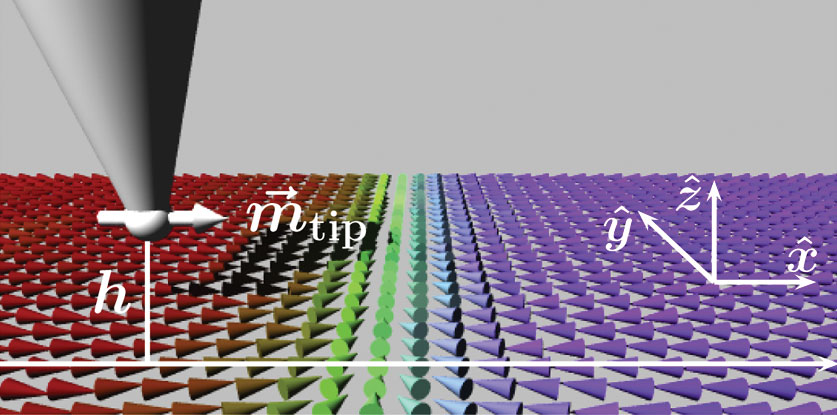
1. Domain Wall Manipulation with a Magnetic Tip.
T. Stapelfeldt, R. Wieser, E.Y. Vedmedenko, and R. Wiesendanger
Phys. Rev. Lett. 107, 027203 (2011)