Showing posts with label Co. Show all posts

Friday, 28 July 2017

Influence of atomic lattice order on crystallinity of NP and their properties when a assembled

Impact of the Metallic Crystalline Structure on the Properties of Nanocrystals and Their Mesoscopic Assemblies.
Marie-Paule Pileni
Accounts of Chemical Research ASAP (2017)
The relation between structural atomic lattice and the degree of crystallinity of NP is nicely demonstrated here. Moreover, properties (mechanical, growth processes) of supracrystals also change with the nanocrystallinity of the nanoparticles used as building blocks.

Wednesday, 25 May 2016

Magnetic properties of large Co clusters

Structural and magnetic properties of large cobalt clusters.
Jaime Souto-Casares, Masahiro Sakurai, and James R. Chelikowsky
Phys. Rev. B 93, 174418 (2016)
Local magnetic moment per atom with respect to the coordination number. Error bars represent the minimum and maximum value. Each set of points has been fitted to a line. A miniature of the specific cluster is shown, with the color map representing the individual local magnetic moment growing in the upper direction.

Thursday, 12 May 2016

Interplay between anisotropy and EB in films

Interplay between magnetocrystalline anisotropy and exchange bias in epitaxial CoO/Co films.
Hao-Liang Liu, Steven Brems, Yu-Jia Zeng, Kristiaan Temst, André Vantomme and Chris Van Haesendonck
Journal of Physics: Condensed Matter 28, 196002 (2016)


Thursday, 3 March 2016

Disentangling magnetic core/shell morphologies in Co-based nanoparticles - Journal of Materials Chemistry C (RSC Publishing)

Disentangling magnetic core/shell morphologies in Co-based nanoparticles.
Natalia Rinaldi-Montes, Pedro Gorria, David Martínez-Blanco, Zakariae Amghouz, Antonio B. Fuertes, Luis Fernández Barquín, Jesús Rodríguez Fernández, Luca Olivi, Giuliana Aquilanti and Jesús A. Blanco

Thursday, 15 October 2015

From shape to surface effects in magnetic anisotropy of Co NPs

Size effects in the magnetic anisotropy of embedded cobalt nanoparticles: from shape to surface.
Simón Oyarzún, Alexandre Tamion, Florent Tournus, Véronique Dupuis, Matthias Hillenkamp

Scientific Reports 5, 14749 (2015)

Comparison of the experimental values for with the magnetic surface anisotropy calculated using the Néel model for different example cluster sizes and single facets added along the [100] (blue, lower curve) and [111] (green, upper curve) directions.

Saturday, 22 August 2015

AF proximity effect in Co NPs

High Temperature Magnetic Stabilization of Cobalt Nanoparticles by an Antiferromagnetic Proximity Effect.
José A. De Toro, Daniel P. Marques, Pablo Muñiz, Vassil Skumryev, Jordi Sort, Dominique Givord, and Josep Nogués

Phys. Rev. Lett. 115, 057201 (2015)

(a) Schematic representation of the Co/CoO−NiO sample. (b) Field-cooled hysteresis loops of the Co/CoO−NiO samples (S series) at 10 K. Shown in the inset is the 10-K hysteresis loop of R80. (c) Field-cooled hysteresis loops of the same samples at 300 K. Shown in the inset are the same loops up to higher fields.


Friday, 5 June 2015

Cobalt-Ferrite Nanoparticles for permanent magnets

Exploring the Magnetic Properties of Cobalt-Ferrite Nanoparticles for the Development of aRare-Earth-Free Permanent Magnet.
Alberto López-Ortega, Elisabetta Lottini, César de Julián Fernández, and Claudio Sangregorio

Chemistry of Materials 27, 4048(2015)
We present for the first time an in-depth magnetic characterization of a family of monodisperse cobaltferrite nanoparticles (NPs) with average size covering a broad range of particles sizes (from 4 to 60 nm), synthesized by thermal decomposition of metal−organic precursors. Metal precursors, surfactants, and synthetic parameters were settled in order to fine-tune the particle size, which preserves a narrow particle size distribution.

Thursday, 12 March 2015

Control of spins of Co atoms

Controlling the Spin of Co Atoms on Pt(111) by Hydrogen Adsorption.
Q. Dubout, F. Donati, C. Wäckerlin, F. Calleja, M. Etzkorn, A. Lehnert, L. Claude, P. Gambardella, and H. Brune
Phys. Rev. Lett. 114, 106807 (2015)
Cobalt atoms exposed to hydrogen gas have higher spins, an effect that could be used to build magnetic nanostructures and lattices.


Monday, 23 February 2015

Surface and EB effects in core/shell and hollow NPs: compiliation

Impacts of surface spins and inter-particle interactions on the magnetism of hollow γ-Fe2O3 nanoparticles.
Hafsa Khurshid, Zohreh Nemati Porshokouh, Manh-Huong Phan, Pritish Mukherjee, and Hariharan Srikanth
J. Appl. Phys. 115, 17E131 (2014)
Temperature dependence of ZFC and FC magnetization taken in a field of 50 Oe for (a) 10 nm and (b) 15 nm hollow particles.
Tuning exchange bias in Fe/γ-Fe2O3 core-shell nanoparticles: Impacts of interface and surface spins.
Hafsa Khurshid, Manh-Huong Phan, Pritish Mukherjee, and Hariharan Srikanth
Temperature dependence of the net moment of frozen spins ( ) for (a) 15 nm, (b) 10 nm, and (c) 8 nm Fe/γ-Fe O nanoparticles. and are plotted as a function of particle size (d).
Mechanism and controlled growth of shape and size variant core/shell FeO/Fe3O4 nanoparticles.
Hafsa Khurshid, Wanfeng Li, Sayan Chandra, Manh-Huong Phan, George C. Hadjipanayis, Pritish Mukherjee and Hariharan Srikanth
Nanoscale 5, 7942 (2013) 
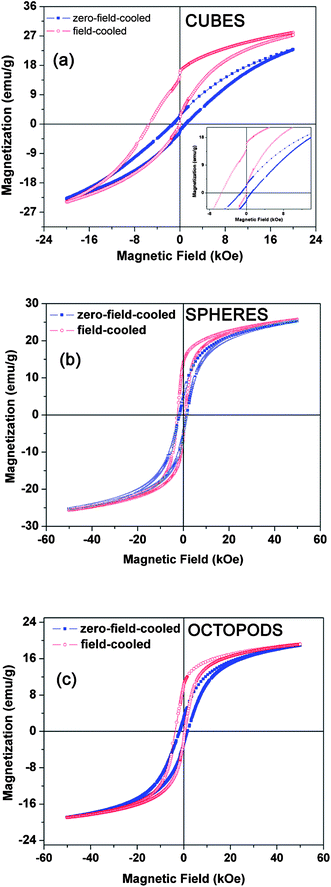
Hysteresis loops (M–H) measured in the ZFC and FC protocols for cubic, spherical, and octopod-shaped FeO/Fe3O4 nanoparticles. The inset of (a) shows an enlarged portion of the M–H curves featuring the low-field jump in the FC magnetization of the cubic nanoparticles. This feature is less pronounced in the case of the octopod-shaped nanoparticles (c) and is almost absent in the case of the spherical nanoparticles (b).
Asymmetric hysteresis loops and its dependence on magnetic anisotropy in exchange biased Co/CoO core-shell nanoparticles.
Sayan Chandra, Hafsa Khurshid, Manh-Huong Phan and Hariharan Srikanth
Appl. Phys. Lett. 101, 232405 (2012)
(a) Temperature dependence of exchange bias field for cooling field of 1 T and (b) temperature dependence of isothermal remanence. Insets in (a) show the ZFC and FC hysteresis loops at 10 K and 100 K. Inset in (b)shows the temperature dependence of blocking function distribution.
Surface spin disorder and exchange-bias in hollow maghemite nanoparticles.
Hafsa Khurshid, Wanfeng Li, Manh-Huong Phan, Pritish Mukherjee, George C. Hadjipanayis and Hariharan Srikanth
Appl. Phys. Lett. 101, 022403 (2012)
The FC ( ) loops taken at 5 K for (a) 9.2 nm and (b) 18.7 nm hollow nanoparticles. The TEM image of the 18.5 nm solid nanoparticles is shown in the inset of (b).

Tuesday, 22 May 2012

DW in a Co nanocontact

Theoretical study of magnetic domain walls through a cobalt nanocontact.
Laszlo Balogh, Krisztian Palotas, Laszlo Udvardi, Laszlo Szunyogh, and Ulrich Nowak
Phys. Rev. B 86, 024406 (2012)
(a) The geometry of the contact viewed from the (110) direction. The leads are depicted as dark (blue) rectangles, the cobalt atoms forming the contact are represented by gray (orange) circles, and a denotes the nearest neighbor distance in
the fcc structure. (b) Sketch of the embedded cluster. Dark (blue) circles: selected atoms of the cobalt leads; gray (orange) circles: cobalt atoms in the nanocontact; empty circles: empty spheres around the contact.

Tuesday, 24 April 2012

Magnetization dynamics of Co antidots

Optically Induced Tunable Magnetization Dynamics in Nanoscale Co Antidot Lattices.
Ruma Mandal, Susmita Saha, Dheeraj Kumar, Saswati Barman, Semanti Pal, Kaustuv Das,Arup Kumar Raychaudhuri, Yasuhiro Fukuma, YoshiChika Otani, and Anjan Barman
ACS Nano 6, 3397 (2012)
We report the time-domain measurements of optically induced precessional dynamics in a series of Co antidot lattices with fixed antidot diameter of 100 nm and with varying lattice constants (S) between 200 and 500 nm. For the sparsest lattice, we observe two bands of precessional modes with a band gap, which increases substantially with the decrease in S down to 300 nm. At S = 200 nm, four distinct bands with significant band gaps appear. The numerically calculated mode profiles show various localized and extended modes with the propagation direction perpendicular to the bias magnetic field. We numerically demonstrate some composite antidot structures with very rich magnonic spectra spreading between 3 and
27 GHz based upon the above experimental observation.

Monday, 12 March 2012

Reversal of individual Co islands

Magnetization Reversal of Individual Co Nanoislands.
S. Ouazi, S. Wedekind, G. Rodary, H. Oka, D. Sander, and J. Kirschner
Phys. Rev. Lett. 108, 107206 (2012)
Island size dependence of the energy barrier Delta E. (a) The blue curve is a linear fit Delta E_lin=K(N-N0)The red curve shows the calculated energy barrier for domain wall formation Delta E_dw= 4 sigma sqrt(AK).
.

Friday, 9 March 2012

Tunnel current induces instability in Co NPs

Magnetic instability induced by tunnel current in single Co nanoparticles.
F. T. Birk, W. Jiang, D. Davidovic
ArXiv 1107.2850 (2012)
A: SEM of a typical sample. The scale bar indicates 0.2μm. B: Sketch representing the sample fabrication process. C-E: Current versus voltage in samples 1-3 (top to bottom), at 60mK and 0T.

Thursday, 8 March 2012

Optical activity in Magnetoplasmonic Nanodisks

High Magneto-Optical Activity and Low Optical Losses in Metal-Dielectric Au/Co/Au–SiO2 Magnetoplasmonic Nanodisks.
Juan Carlos Banthí, David Meneses-Rodríguez, Fernando García, María Ujué González, Antonio García-Martín, Alfonso Cebollada, Gaspar Armelles
Advanced Materials 24, OP36 (2012)
a) Sketch of the composition of the fabricated nanodisks. b) AFM image of a selected fabricated structure (15 nm Au/10 nm Co/20 nm SiO2/15 nm Au).

Friday, 24 February 2012

Co nanopeapods

Fabrication of Nanopeapods: Scrolling of Niobate Nanosheets for Magnetic Nanoparticle Chain Encapsulation.
Yuan Yao, Girija S. Chaubey, and John B. Wiley
JACS 134, 2450 (2012)
Proposed mechanism for the formation of a nanopeapod. (a) Co NPs nucleate and grow in solution. (b) NPs assemble and form a chain on the surface of a niobateNS. (c, d) The niobate NS scrolls around the chain. (e) Nanopeapods form and separate from the niobate NSs.

Friday, 17 February 2012

Assymetric MR in EB bilayers

Asymmetric magnetoresistance in an exchange bias Co/CoO bilayer.
Sarbeswar Sahoo, Srinivas Polisetty, Yi Wang, Tathagata Mukherjee, Xi He, Sitaram S Jaswal and Christian Binek
J. Phys.CM 24, 096002 (2012)
Selected magnetoresistance curves with the external field H oriented parallel to the current I measured after cooling in a
field of 0H D 0:2 T from 320 K to the respective temperatures. The lines are the best fits according to equation (4).

Tuesday, 10 January 2012

Em field distribution in a nanodisk

Probing the Electromagnetic Field Distribution within a Metallic Nanodisk.
David Meneses-Rodríguez , Elías Ferreiro-Vila , Patricia Prieto, José Anguita , María U. González , José M. García-Martín , Alfonso Cebollada, Antonio García-Martín, and Gaspar Armelles
Small 7, 3317 (2011)

EB in Co/CoO/Co trilayers

Interplay between the antiferromagnetic spin configuration and the exchange bias effect in [Pt/Co]8/CoO/Co3Pt trilayers.
Tobias Kosub,  Denys Makarov, Herbert Schletter, Michael Hietschold, and Manfred Albrecht
Phys. Rev. B 84, 214440 (2011)
Temperature dependences of the coercive (upward triangles) and EB fields (downward triangles) of each of the
F layers in the trilayer stack: (a) [Pt/Co]8 and (b) Co3Pt.

Sunday, 20 November 2011

Co-W NPs

Structural and magnetic properties of amorphous Co-W alloyed nanoparticles.
A. I. Figueroa, J. Bartolomé, L. M. García, F. Bartolomé, C. Magén,A. Ibarra, L. Ruiz, J. M. González-Calbet, F. Petroff, C. Deranlot, S. Pascarelli, P. Bencok, N. B. Brookes, F. Wilhelm, and A. Rogalev
Phys. Rev. B 84, 184423 (2011)
Dependence of Keff with mL/mS for the a series of Co-W samples and comparison with those for the bulk Co
(Ref. 67), bare Co NPs with tCo = 0.7 nm (Ref. 14), and Co-Pt NPs with comparable diameters (Ref. 16).

Sunday, 30 October 2011

TMR modulation in single nanoislands

Spatially Modulated Tunnel Magnetoresistance on the Nanoscale.
Hirofumi Oka, Kun Tao, Sebastian Wedekind, Guillemin Rodary, Valeri S. Stepanyuk, Dirk Sander, and Jü rgen Kirschner
Phys. Rev. Lett. 107, 187201 (2011)
Maps of the TMR ratio obtained at the indicated voltages(e)–(g) Line profiles, averaged over 6
adjacent lines for an improved signal-to-noise ratio, of the TMR ratio images along the yellow arrows in (b)–(d).