Showing posts with label Nanotubes. Show all posts

Monday, 24 February 2020

Helicity control in magnetic nanotubes

Tailoring dual reversal modes by helicity control in ferromagnetic nanotubes.
H. D. Salinas, J. Restrepo, and Òscar Iglesias
Phys. Rev. B 101, 054419 (2020)
Magnetic configurations along the hysteresis loops for the different reversal modes displayed in Fig. 4 (left and right columns correspond to panels (a) and (c) of that figure). Upper panels represent the height profiles of the quantities ⟨θ⟩, ⟨mz⟩, and <mϕ⟩  averaged per layer for the tube (8,15) and γ= 0.035, whereas lower ones present snapshots of the spin configurations taken at points labeled in Fig. 4.

Tuesday, 18 July 2017

Vortices in ferromagnetic nanotubes

Imaging magnetic vortex configurations in ferromagnetic nanotubes.
M. Wyss, A. Mehlin, B. Gross, A. Buchter, A. Farhan, M. Buzzi, A. Kleibert, G. Tütüncüoglu, F. Heimbach, A. Fontcuberta i Morral, D. Grundler, and M. Poggio

Phys. Rev. B 96, 024423 (2017)
XMCD-PEEM images of a 6.9-μm-long Py NT with (a) ˆk⊥ˆn and (b) ˆk∥ˆn and of a 7.2-μm-long CoFeB NT with (c) ˆk⊥ˆn and (d) ˆk∥ˆn. Dashed outlines indicate the positions of the NTs. Panels (e–h) represent 2-μm-long IXMCDlinecuts along the corresponding colored dashed lines in (a–d). In the linecuts, the background intensity is indicated by the level of the horizontal dashed lines and vertical dashed lines delineate the boundaries of the NT. Panels (i) and (j) show simulated remnant magnetic states for a NT with l=2.1μm and d=245 nm. Both configurations are mixed states with an axial central domain and vortex ends of either (i) opposing circulation—consistent with (a) and (b)—or (j) matching circulation—consistent with (c) and (d). The color scale corresponds to normalized magnetization along ˆy. Arrowheads indicate the local magnetization direction.


Tuesday, 23 February 2016

Dipolar helices

Structure and cohesive energy of dipolar helices.
Igor Stankovic,Miljan Dasic and René Messina
Soft Matter 12, 3056 (2016)
This paper deals with the investigation of cohesive energy in dipolar helices made up of hard spheres. Such tubular helical structures are ubiquitous objects in biological systems. We observe a complex dependence of cohesive energy on surface packing fraction and dipole moment distribution. As far as single helices are concerned, the lowest cohesive energy is achieved at the highest surface packing fraction.

Wednesday, 23 December 2015

Magnetization reversal of an individual exchange-biased permalloy nanotube

Magnetization reversal of an individual exchange-biased permalloy nanotube.
A. Buchter, R. Wölbing, M. Wyss, O. F. Kieler, T. Weimann, J. Kohlmann, A. B. Zorin, D. Rüffer, F. Matteini, G. Tütüncüoglu, F. Heimbach, A. Kleibert, A. Fontcuberta i Morral, D. Grundler, R. Kleiner, D. Koelle, and M. Poggio
Phys. Rev. B 92, 214432 (2015)
Training effect: (a) SQUID and (b) DCM hysteresis loops for different loop number n at T=3.4 K. Red and blue curves indicate up- and down-sweep, respectively. Evolution of (c) exchange field and (d) coercivity with increasing loop number n extracted from SQUID data set. Dashed line fits the data according to Eq. (2). Point size corresponds to the measurement error in field

Monday, 23 February 2015

DWs in magnetic nanotubes

Chiral symmetry breaking and pair-creation mediated Walker breakdown in magnetic nanotubes.
Ming Yan, Christian Andreas, Attila Kákay, Felipe García-Sánchez and Riccardo Hertel Appl. Phys. Lett. 100, 252401 (2012)
(a) Simulated configuration of a vortex-like DW formed in a magnetic nanotube and the definition of its chirality by combining vorticity and field direction. (b) The unrolled tube with the DW. The red line is the plot of the radial component averaged over each cross-section. (c) For comparison, a transverse DW in a flat strip.

Friday, 30 March 2012

Chirality switching of a vortex DW

Chirality switching and propagation control of a vortex domain wall in ferromagnetic nanotubes.
J. A. Otálora, J. A. López-López, P. Vargas, and P. Landeros
Appl. Phys. Lett. 100, 072407 (2012)
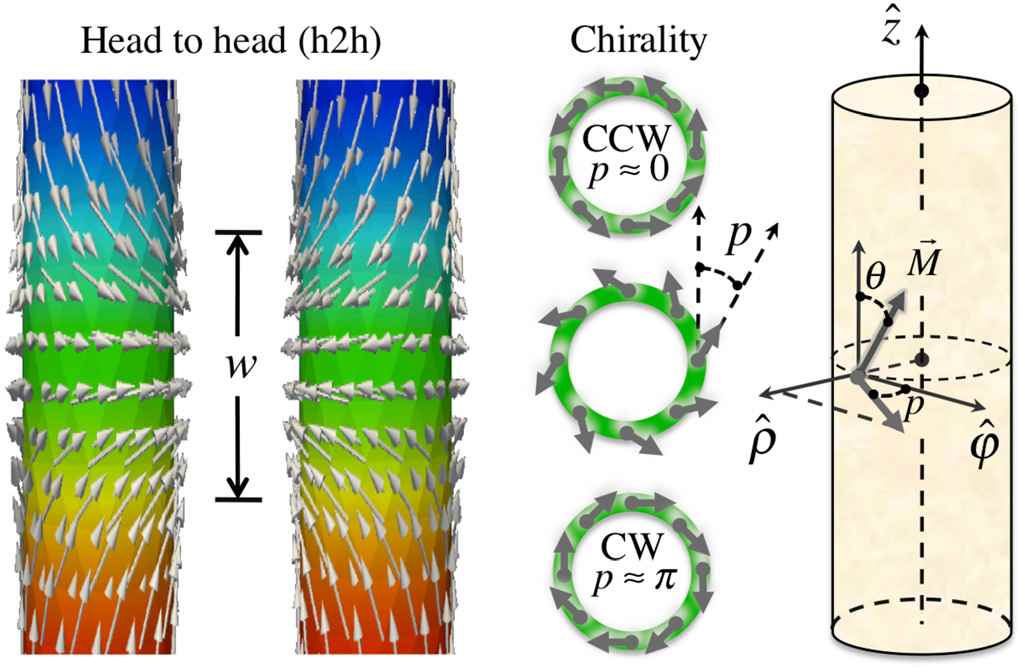
Illustration of a h2h VDW in MNTs. Counterclockwise (p = 0) and clockwise (p =pi) are the possible vortex chiralities. The magnetization components can be expressed through the angles theta and p, and the main properties of the DW are cast by the position in the z axis, the wall width w, and the DW magnetization angle p.

Tuesday, 10 January 2012

Influence of lattice geometry on TC of nanotubes

Influence of the structural properties on the pseudocritical magnetic behavior of single-wall ferromagnetic nanotubes.
C.D. Salazar-Enríquez , E.Restrepo-Parra , J.Restrepo
JMMM 324, 1631 (2012)
Critical temperature as a function of the nanotube diameter for SMNTs and HMNTs.