Tuesday, 13 March 2012

Altered magnetism in maghemite NP by Cu shell

Tuning the surface magnetism of gamma-Fe2O3 nanoparticles with a Cu shell.
R. D. Desautels, E. Skoropata, Y.-Y. Chen, H. Ouyang, J. W. Freeland, and J. van Lierop
Appl. Phys. Lett. 99, 262501 (2011)

Increased surface spin stability in gamma -Fe2O3 nanoparticles with a Cu shell
R. D. Desautels, E. Skoropata, Y.-Y. Chen, H. Ouyang, J. W. Freeland, and J. van Lierop 
J. Phys. CM 24, 146001 (2012) 

Field dependence of the interfacial Cu in Cu-coated c-Fe2O3 nanoparticles.
R. D. Desautels, Y.-Y. Chen, H. Ouyang, S.-C. Lo, J. W. Freeland, and J. van Lierop

J. Appl. Phys. 111, 07B518 (2012) 
Temperature dependence of the saturation magnetization (Ms, top) and the exchange bias loop shift, Hex, of the bare gamma-Fe2O3 and Cu(0.5 nm)/Fe2O3 nanoparticles. The inset shows typical M vs mu0 H behavior of the Cu(0.5 nm)/gamma-Fe2O3 nanoparticles

Magnetization distribution in an FeO NP by SANS

Quantitative spatial magnetization distribution in iron oxide nanocubes and nanospheres by polarized small-angle neutron scattering.
S Disch1, E Wetterskog, R P Hermann, A Wiedenmann,U Vainio, G Salazar-Alvarez, L Bergström and Th Brücke
New Journal of Physics 14, 013025 (2012)
Purely nuclear SANS of spherical and cubic nanoparticles (scaled by 0.5 for display). Lines indicate fits to the model depicted in the right inset. Left inset: 10 deg sectors used for integrating the two-dimensional (2D) scattering.

Monday, 12 March 2012

Reversal of individual Co islands

Magnetization Reversal of Individual Co Nanoislands.
S. Ouazi, S. Wedekind, G. Rodary, H. Oka, D. Sander, and J. Kirschner
Phys. Rev. Lett. 108, 107206 (2012)
Island size dependence of the energy barrier Delta E. (a) The blue curve is a linear fit Delta E_lin=K(N-N0)The red curve shows the calculated energy barrier for domain wall formation Delta E_dw= 4 sigma sqrt(AK).
.

Fe3O4–Au NPs for biomedical applications

A Simple Approach to the Design and Functionalization of Fe3O4–Au Nanoparticles for Biomedical Applications.
A. Narsi Reddy, K. Anjaneyulu, Dr. Pratyay Basak, Dr. N. Madhusudhana Rao and Dr. Sunkara V. Manorama
ChemPlusChem ASAP (2012)
A simple aqueous synthesis of a superparamagnetic and biofunctional nanocomposite system is described. Chitosan-stabilized Fe3O4 nanoparticles were synthesized at room temperature and the surface charge of these nanocomposites was exploited to prepare nanoparticles decorated with gold.
 

Friday, 9 March 2012

Tunnel current induces instability in Co NPs

Magnetic instability induced by tunnel current in single Co nanoparticles.
F. T. Birk, W. Jiang, D. Davidovic
ArXiv 1107.2850 (2012)
A: SEM of a typical sample. The scale bar indicates 0.2μm. B: Sketch representing the sample fabrication process. C-E: Current versus voltage in samples 1-3 (top to bottom), at 60mK and 0T.

Thursday, 8 March 2012

EB induced by biquadratic interface exchange coupling

Flipping magnetization induced by noncollinear ferromagnetic-antiferromagnetic exchange coupling.
B. Y. Wang, C. H. Chuang, S. S. Wong, J. J. Chiou, W. C. Lin, Y. L. Chan, D. H. Wei, and Minn-Tsong Lin
Phys. Rev. B 85, 094412 (2012)
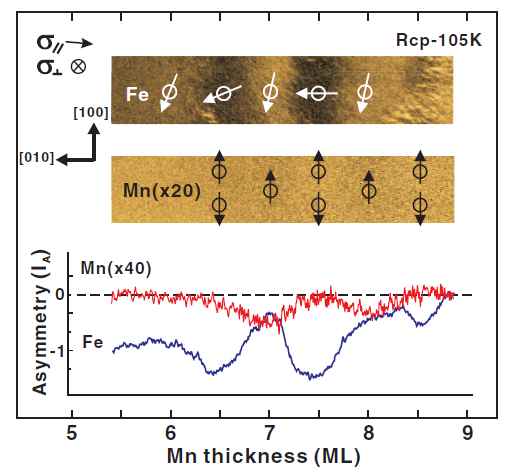
The Fe and Mn domain images as functions of tMn, taken at 105 K, at the region where the Fe film reveals the flipping magnetization (indicated by white arrows). The Mn layer yields nonvanishing IA at integer layer thickness and
approaches to zero value at half-integer layer thickness. A very small IA signal for the Mn layer could be attributed to a nearly orthogonal included angle between the photohelicity and in-plane magnetization.

Charge and spin currents resulting from thermal gradient

Local Charge and Spin Currents in Magnetothermal Landscapes.
Mathias Weiler, Matthias Althammer, Franz D. Czeschka, Hans Huebl, Martin S. Wagner, Matthias Opel, Inga-Mareen Imort, Günter Reiss, Andy Thomas, Rudolf Gross, and Sebastian T. B. Goennenwein
Physics 5, 29 (2012)

Spin-Heat Vision
Roberto Myers, Joseph Heremans
Physics 5, 29 (2012)

(a) The scannable laser beam generates a local temperature gradient rT normal to the ferromagnetic thin film plane. The dc voltage VANE which arises due to the anomalous Nernst effect depends on the local magnetization M at the position ðx; yÞ of the laser beam. All investigated samples are patterned into 80 microm wide and 900 microm long Hall bars with contacts abeled as sketched. (b) VANE determined between contacts 2 and 4 as a function of the laser-spot position (x; y)and the external magnetic field magnitude H in a 50 nm thickCo2FeAl (CFA) film.

Optical activity in Magnetoplasmonic Nanodisks

High Magneto-Optical Activity and Low Optical Losses in Metal-Dielectric Au/Co/Au–SiO2 Magnetoplasmonic Nanodisks.
Juan Carlos Banthí, David Meneses-Rodríguez, Fernando García, María Ujué González, Antonio García-Martín, Alfonso Cebollada, Gaspar Armelles
Advanced Materials 24, OP36 (2012)
a) Sketch of the composition of the fabricated nanodisks. b) AFM image of a selected fabricated structure (15 nm Au/10 nm Co/20 nm SiO2/15 nm Au).

Wednesday, 7 March 2012

Magnetization reversal by laser pulses

All-optical magnetization reversal by circularly polarized laser pulses: Experiment and multiscale modeling.
K. Vahaplar, A. M. Kalashnikova, A. V. Kimel, S. Gerlach, D. Hinzke, U. Nowak, R. Chantrell, A. Tsukamoto, A. Itoh, A. Kirilyuk, and Th. Rasing
Phys. Rev. B 85, 104402 (2012)
(a) The magnetization evolution in Gd24Fe66.5Co9.5 after the excitation with σ+ and σ− circularly polarized pulses
at room temperature. (b) The averaged magnetization in the switched areas (∼5 μm) after σ+ and σ− laser pulses. (c) and (d) are results of multimacrospin simulations.

Friday, 2 March 2012

Nanotechnology on cosmetics: a review

Current status and future prospects of nanotechnology in cosmetics.
Albert Mihranyan, Natalia Ferraz, Maria Strømme
Progress in Materials Science 57, 875 (2012)
Examples of nanocarrier delivery vehicles

Wednesday, 29 February 2012

Review on Domain wall nanoelectronics

Domain wall nanoelectronics.
G. Catalan, J. Seidel, R. Ramesh, J. F. Scott
Rev. Mod. Phys. 84, 119 (2012)
Ferroelectric ‘‘closure stripes’’ predicted by atomistic simulations of ultrathin films.

Tuesday, 28 February 2012

Simulations of spin models on GPUs

Some recent articles reporting the implementation of Monte Carlo simulations on GPUs:

GPU-based Swendsen–Wang multi-cluster algorithm for the simulation of two-dimensional classical spin systems.
Yukihiro Komura, Yutaka Okabe

http://www.sciencedirect.com/science/article/pii/S001046551200032X
 
Simulating spin models on GPU
Martin Weigel
http://dx.doi.org/10.1016/j.cpc.2010.10.031

GPU accelerated Monte Carlo simulations of lattice spin models
M. Weigel, T. Yavors’kii
Physics Procedia 15 (2011) 92–96

Benchmarking GPU and CPU codes for Heisenberg spin glass over-relaxation
M. Bernaschi , G. Parisi , L. Parisi
Computer Physics Communications 182 (2011) 1265–1271

Simulating Lattice Spin Models on Graphics Processing Units
Tal Levy, Guy Cohen, and Eran Rabani
J. Chem. Theory Comput. 2010, 6, 3293–3301

Multi-GPU accelerated multi-spin Monte Carlo simulations of the 2D Ising model ✩
Benjamin Block, Peter Virnau, Tobias Preis
Computer Physics Communications 181 (2010) 1549–1556

GPU accelerated Monte Carlo simulation of the 2D and 3D Ising model q
Tobias Preis, Peter Virnau, Wolfgang Paul, Johannes J. Schneider
Journal of Computational Physics 228 (2009) 4468

http://www.tobiaspreis.de/gpgpu.html

Prediction of magnetic arrays

On thermalization of magnetic nano-arrays at fabrication. Cristiano Nisoli
New J. Phys. 14 035017 (2012)

Left: arrays of different lattice constants grown at the same fabrication temperature show an ordered microstate when the lattice constant is smaller than a critical value ac. In the figure we plot the blocking temperature Tb(h) and the critical temperatures Tc(h) for arrays of three different values of the lattice constant (a > ac, a < ac, a = ac (this last one in red)) as a function of the height of the nano-islands h. h* is the stopping height, after which Tb >  T and therefore freezing-in starts.Right: during the fabrication of arrays of equal lattice constant the microstate can be controlled by varying the temperature T at deposition.

Low energy dynamics of ordered spin ice

Spin dynamics in the ordered spin ice Tb2Sn2O7.
Sylvain Petit, Pierre Bonville, Isabelle Mirebeau, Hannu Mutka, and Julien Robert
Phys. Rev. B 85, 054428 (2012)
Map of the powder average S(Q,ω) in Tb2Sn2O7 measured (left column) at 1.3 K (top) and 65 mK (middle), and calculated (right column)

Giant EB in multiferroics

Giant exchange bias in a nanocomposite of BiFeO3-Bi2Fe4O9
Tuhin Maity and Saibal Roy, Sudipta Goswami and Dipten Bhattacharya
ArXiv 1202.5898 (2012)
(a) The spontaneous exchange bias observed at different temperatures under zero-field cooling (b) the conventional EB observed under magnetic annealing at 5 K; it turns out to be negative in this case too

Dipolarly coupled vortex oscillators

Phase locking dynamics of dipolarly coupled vortex-based spin transfer oscillators.
A.D. Belanovsky, N. Locatelli, P.N. Skirdkov, F. Abreu Araujo, J. Grollier, K.A. Zvezdin, V. Cros, and A.K. Zvezdin
ArXiv 1202.5499 (2012)
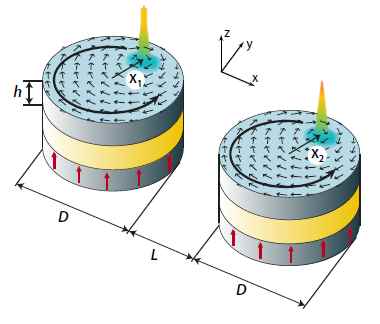
Schematic representation of two inter-acting spin-transfer oscillators. Each pillar is composed by a free magnetic layers with vortex, a non magnetic spacer, and a SAF polarizer. Red arrows indicates the direction of spin polarization created by the polarizer. The nanopillars have a diameter D = 200 nm and are separated by a distance L. The parameters X1 and X2 define the cores positions.

Fe magnetic moment a MgO interface

Interfacial geometry dependence of the iron magnetic moment: The case of MgO/Fe/MgO.
Juan Ignacio Beltrán, Lluis Balcells, and Carlos Martínez-Boubeta
Phys. Rev. B 85, 064417 (2012)
Magnetic moment averaged per Fe atom from SQUID measurements (black circles), together with theoretical calculations of MgO/Fe/MgO structures with symmetric Fe-O bonding (green diamonds), and asymmetric coordination (blue triangles), as a function of the Fe thickness. The experimental data are fitted to a phenomenological exponential decaying function (as
mm = mmbulk + mmsurface e[1−thickness]/k, with the characteristic decay length k = 6 ML), which converge at large coverage to bulk Fe values.

Monday, 27 February 2012

Modeling antidots arrays

Micromagnetic modelling of the anisotropy properties of permalloy antidot arrays with hexagonal symmetry.
A Manzin and O Bottauscio
J. Phys. D 45, 095001 (2012)
Magnetic domain configurations at remanent state for an antidot film with hole diameter d = 200 nm and centre-to-centre
nearest-neighbour hole distance T = 500 nm, considering (a) β = 0◦ and (b) β = 90◦.

Saturday, 25 February 2012

Finite-size effects and charge ordering suppresion on manganite NPs

Particle-size effects on the suppression of charge ordering in Nd0.8Na0.2MnO3
B. Samantaray, S. K. Srivastava, and S. Ravi
J. Appl. Phys. 111, 013919 (2012)
The phase diagrams of Nd0.8Na0.2MnO3 for (a) D=700-nm, (b) D=250-nm, and (c) D=140-nm particle-size samples
obtained from magnetization measurements. Open and closed circles represent the threshold fields HC1 and HC2, respectively, and stars represent HS values.

Friday, 24 February 2012

Quantum magnetism of individual Mn12 cluster

The Quantum Magnetism of Individual Manganese-12-Acetate Molecular Magnets Anchored at Surfaces
Steffen Kahle, Zhitao Deng, Nikola Malinowski, Charlène Tonnoir, Alicia Forment-Aliaga, Nicha Thontasen, Gordon Rinke, Duy Le, Volodymyr Turkowski, Talat S. Rahman,Stephan Rauschenbach, Markus Ternes, and Klaus Kern
Nano Letters 12, 518 (2012)
Here we demonstrate that electrospray ion beam deposition facilitates grafting of intact Mn12 molecules on metal as well as ultrathin insulating surfaces enabling submolecular resolution imaging by scanning tunneling microscopy. Using scanning tunneling spectroscopy we detect spin excitations from the magnetic ground state of the molecule at an ultrathin boron nitride decoupling layer. Our results are supported by density functional theory based calculations and establish that individual Mn12 molecules retain their intrinsic spin on a well chosen solid support.

Molecular magnet networks in all dimensions

Dimensionality Selection in a Molecule-Based Magnet.
Paul A. Goddard, Jamie L. Manson, John Singleton, Isabel Franke,1 Tom Lancaster, Andrew J. Steele,Stephen J. Blundell, Christopher Baines, Francis L. Pratt, Ross D. McDonald, Oscar E. Ayala-Valenzuela,Jordan F. Corbey, Heather I. Southerland, Pinaki Sengupta, and John A. Schlueter
Phys. Rev. Lett. 108, 077208 (2012)
(a) Normalized pulsed-field magnetization of planar (T = 1.5 K), and chainlike  (T =0:5 K) Mn12 compunds. (b) The results of QMC simulations of the low-temperature magnetization for 3D  2D and 1D AF. The lines are the pulsed-field data scaled by the saturation field (Bc). (c) The relation between the exchange anisotropy and the ratio of critical temperature and primaryexchange energy in Q1D and Q2D antiferromagnets deduced from QMC simulations (d) Anisotropy of the g factor in the planar and (e) chainlike compounds measured using ESR at 10 K and 1.5 K, respectively.

Improving biomedical applications of Fe oxide NPs

Ultrasmall Iron Oxide Nanoparticles for Biomedical Applications: Improving the Colloidal and Magnetic Properties.
Rocio Costo, Valentina Bello, Caroline Robic, Marc Port, Jose F. Marco, M. Puerto Morales, and
Sabino Veintemillas-Verdaguer
Langmuir 28, 178 (2012)
A considerable increase in the saturation magnetization, Ms (40%), and initial susceptibility of ultrasmall (<5 nm) iron oxide nanoparticles prepared by laser pyrolysis was obtained through an optimized acid treatment. Moreover, a significant enhancement in the colloidal properties, such as smaller aggregate sizes in aqueous media and increased surface charge densities, was found after this chemical protocol. The results are consistent with a reduction in nanoparticle surface disorder induced by a dissolution–recrystallization mechanism.

Ferroelectric solid state memories

Solid-state memories based on ferroelectric tunnel junctions.
André Chanthbouala, Arnaud Crassous, Vincent Garcia, Karim Bouzehouane, Stéphane Fusil, Xavier Moya, Julie Allibe, Bruno Dlubak, Julie Grollier, Stéphane Xavier, Cyrile Deranlot, Amir Moshar, Roger Proksch, Neil D. Mathur, Manuel Bibes and Agnés Barthélémy
Nature Nanotechn. 7, 101 (2012)
Ferroelectric switching versus resistive switching. a,b, Out-ofplane PFM phase (a) and amplitude (b) measurements on a typical gold/cobalt/BTO/LSMO ferroelectric tunnel junction. c, R(Vwrite) for a similar capacitor measured in remanence (Vread¼100 mV) after applying successive voltage pulses of 100 ms. The open and filled circles represent two different scans to show reproducibility.

Nanoelectronics: Ferroelectric devices show potential.
Adrian M. Ionescu
Nature Nanotechn. 7, 83 (2012)
The ferroelectric tunnel junction as a non-volatile memory cell.

Temperature dependence of Magnetite anisotropy

Magnetocrystalline anisotropy of magnetite.
R Reznıcek, V Chlan, H Stepankova, P Novak and M Marysko
J. Phys. CM 24, 055501 (2012)

Co nanopeapods

Fabrication of Nanopeapods: Scrolling of Niobate Nanosheets for Magnetic Nanoparticle Chain Encapsulation.
Yuan Yao, Girija S. Chaubey, and John B. Wiley
JACS 134, 2450 (2012)
Proposed mechanism for the formation of a nanopeapod. (a) Co NPs nucleate and grow in solution. (b) NPs assemble and form a chain on the surface of a niobateNS. (c, d) The niobate NS scrolls around the chain. (e) Nanopeapods form and separate from the niobate NSs.