Xavier Moya, Emmanuel Defay, Volker Heine and Neil D. Mathur
Nature Physics 11, 202 (2015)

Caloric materials efficiency map.
 |
| Hysteresis loops for FeF2(70 nm)/NiFe (30 and 100 nm) bilayers at (a) T=10 and (b) T=70 K. Symbol: Experimental data. Blue solid line in (a): Simulation. |
 |
| (a) Size dependence of experimentally measured (black solid (T = 5 K) and dashed (300 K) lines) and calculated saturation magnetization MS of CoO octahedra. A magnetic moment μ of (4.8 ± 0.4)μB per Co2+ ion and a shell thickness of 3 nm Co3O4 is assumed. MS arises only from the Co cations at the surfaces or interfaces of the octahedral nanocrystals, as indicated in the schematic in (b). The blue lines are calculated values assuming only effectively one layer of Co2+ cations at the Co3O4 surface, while the red lines correspond to a double layer of Co cations at the interface. |
 |
Cobalt
oxide octahedra were synthesized by thermal decomposition. Each
octahedron-shaped nanoparticle consists of an antiferromagnetic CoO core
enclosed by eight {111} facets interfaced to a thin (∼4 nm) surface
layer of strained Co3O4. The nearly perfectly
octahedral shaped particles with 20, 40, and 85 nm edge length show a
weak room-temperature ferromagnetism that can be attributed to
ferromagnetic correlations appearing due to strained lattice
configurations at the CoO/Co3O4 interface.
|
 |
| Increased coercive and tunable exchange bias field values were registered in hybrid CoO@Fe3O4 core–shell octahedron-shaped nanoparticles of different average size. In this strained morphology, the metal cation chemical potentials at the interface between the antiferromagnetic and ferrimagnetic oxides become a very dynamic variable. This causes the effective magnetic anisotropy to increase and the type of interface to change after growing the magnetite shell epitaxially onto the cobalt oxide {111} surface facets and, consequently, to tune the exchange bias effect. |
 |
| Spin dynamics of the skyrmion excited by an AC magnetic field
|
 |
| Examples of magnetic and spintronic properties that can be controlled by an electric field. DOS denotes density of states. |
 |
| Spin textures of cubic chiral helimagnets and their collective excitations. |
 |
| TRM for FexNi1−xF2 samples measured in H=0 after field cooling in HFC=100 Oe. Data for x=0 and 0.10 were measured with HFC perpendicular to the c axis; all others measured with HFC parallel to the c axis. Right: Magnetic and crystalline structures of the parent compounds NiF2 (x=0) and FeF2 (x=1). Yellow, blue, and red dots are F−, Ni2+, and Fe2+ ions, respectively. |
 |
| (a) Illustration of the head-to-head DW in the nanowire using red-blue opaque arrows. The translucent purple arrows represent a spin wave excitation. The DMI exerts a torque to change the DW tilt angle when spin waves pass through the DW. (b) DW profile using Eq. (5) with parameters A=8.78×10⁻¹² J/m, K=1×10⁵ J/m3, D=1.58×10⁻³ J/m2, K⊥=0 and Φ=0. The red dashed line shows the simulation data for mz with K⊥2=6×10⁵ J/m3: the easy-plane anisotropy favors a reduced mz. (c) The dispersion relations inside and outside the DW |
 |
| Spin textures of cubic chiral helimagnets and their collective excitations. |
 |
| Morphological and structural evolution of magnetic nanoparticle and correlated tunability of nanomagnetism. (a) Magnetic NPs with various structural motifs exhibiting differences in size, surface anisotropy, and exchange anisotropy. (b) Magnetism tuning by the systematicchanges of magnetic nanoparticles. Graphs i−iv correspond to the nanoparticles shown in part a where modulation of structural motifs is needed to control parameters such as K, Hc, Ms, or Mr. |
 |
| Images and magnetization behaviors of cube and sphere nanoparticles. (a) TEM images of cube (18 nm (σ ≈ 5%) in edge length) and (b) sphere nanoparticle (22 nm (σ ≈ 7%) in diameter). Nanoparticles have identical composition (Zn0.4Fe2.6O4) and magnetic volume (5.8 × 10⁻²⁴ m3). (c) High resolution TEM image of cube exhibiting well-defined lattice fringes of {100} faces. (d) M-H curves of cube and sphere measured at 300 K using SQUID. Ms of cube is 165 emu/g(Fe+Zn), and that of sphere is 145 emu/g(Fe+Zn). Simulated magnetic spin states of (e) cube and (f) sphere by using OOMMF program. The color map indicates the degree of spin canting against external magnetic field (B0) where red indicates nondeviated spins and blue indicates highly canted spins. Local spin states on the surfaces of nanoparticles are depicted on the right corners of parts e and f. Cube exhibits lower spin disorder rate of 4% than sphere of 8%. |
 |
| Schematic Illustration of Synthesis and Modification of Fe3O4/TaOx Core/Shell NPs |
 |
| Low temperature hysteresis loops simulated after a cooling in a magnetic field hFC = 100 K as computed by MC simulations of individual nanoparticles with cluster (a) and dimer (b) geometries. The non-magnetic metal is simulated as a hole in the middle for the cluster geometry and a sharp facet for the cluster. Panels (a) and (b) show hysteresis loops of a particle with cluster and dimer geometry, respectively, for two different values of the surface anisotropy constant: kS = 0.01 (blue squares) equal to the core value kC = 0.01, and increased surface anisotropy kS = 30 (red circles). The dashed lines in (b) stand for a spherical particle of the same size as the dimer. The inset displays the contribution of the surface (yellow circles) and core (green squares) spins of a dimer particle to the hysteresis loop for ks = 30. Snapshots of the spin configurations for cluster ((c) and (d) panels) and dimer ((e) and (f) panels) particles for kS = 30 obtained at the end of the FC process ((c) and (e) panels) and at the coercive field point of the decreasing field branch ((d) and (f) panels) of the hysteresis loops displayed in figures (a) and (b). For clarity, only a slice of width 4a along the applied field direction and through the central plane of the particles is shown. Surface spins have darker colors and core spins have been colored lighter. |
 |
| (a) ZFC-FC magnetization curves of Fe3O4 and Au–Fe3O4 NPs measured under an applied field of 25 Oe. (b) Hysteresis loops of Fe3O4 and Au–Fe3O4 NPs with Au : Fe initial molar ratios of 1 : 1 and 1 : 3 measured at 5 K applying a maximum field of 50.000 Oe. The ferromagnetic behaviour is highlighted in the inset. |
 |
| We report a broadband 1H NMR study of the spin dynamics of coated maghemite and gold–maghemite hybrid nanostructures with two different geometries, namely dimers and core–shells. All the samples have a superparamagnetic behavior, displaying a blocking temperature (TB ∼ 80 K (maghemite), ∼105 K (dimer), ∼150 K (core–shell)), and the magnetization reversal time follows the Vogel–Fulcher law. We observed three different anomalies in 1H NMR T1–1 versus T that decrease in amplitude when increasing the applied magnetic field. We suggest that the anomalies are related to three distinct system dynamics: molecular rotations of the organic groups (240 < T < 270 K), superparamagnetic spin blockage (100 < T < 150 K), and surface–core spin dynamics (T < 25 K). By fitting the T1–1 data with a heuristic model, we achieved a good agreement with magnetic relaxation data and literature values for methyl group rotation frequencies. |
 |
| We report on the unprecedented direct observation of spin-polarization transfer across colloidal magneto-plasmonic Au@Fe-oxide core@shell nanocrystal heterostructures. A magnetic moment is induced into the Au domain when the magnetic shell contains a reduced Fe-oxide phase in direct contact with the noble metal. An increased hole density in the Au states suggested occurrence of a charge-transfer process concomitant to the magnetization transfer. The angular to spin magnetic moment ratio, morb/mspin, for the Au 5d states, which was found to be equal to 0.38, appeared to be unusually large when compared to previous findings. A mechanism relying on direct hybridization between the Au and Fe states at the core/shell interface is proposed to account for the observed transfer of the magnetic moment. |
 |
| Temperature dependence of ZFC and FC magnetization taken in a field of 50 Oe for (a) 10 nm and (b) 15 nm hollow particles. |
 |
| Temperature dependence of the net moment of frozen spins ( M f ) for (a) 15 nm, (b) 10 nm, and (c) 8 nm Fe/γ-Fe 2O 3 nanoparticles. H EB and M f are plotted as a function of particle size (d). |
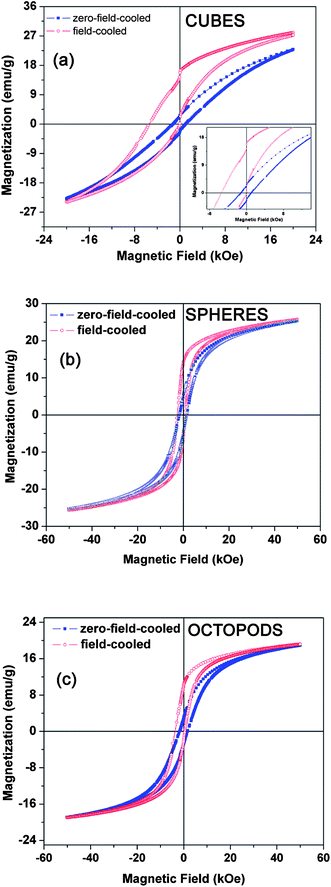 |
| Hysteresis loops (M–H) measured in the ZFC and FC protocols for cubic, spherical, and octopod-shaped FeO/Fe3O4 nanoparticles. The inset of (a) shows an enlarged portion of the M–H curves featuring the low-field jump in the FC magnetization of the cubic nanoparticles. This feature is less pronounced in the case of the octopod-shaped nanoparticles (c) and is almost absent in the case of the spherical nanoparticles (b). |
 |
| (a) Temperature dependence of exchange bias field for cooling field of 1 T and (b) temperature dependence of isothermal remanence. Insets in (a) show the ZFC and FC hysteresis loops at 10 K and 100 K. Inset in (b)shows the temperature dependence of blocking function distribution. |
 |
| The FC M( H) loops taken at 5 K for (a) 9.2 nm and (b) 18.7 nm hollow nanoparticles. The TEM image of the 18.5 nm solid nanoparticles is shown in the inset of (b). |
 |
| (a) Simulated configuration of a vortex-like DW formed in a magnetic nanotube and the definition of its chirality by combining vorticity and field direction. (b) The unrolled tube with the DW. The red line is the plot of the radial component averaged over each cross-section. (c) For comparison, a transverse DW in a flat strip. |
 |
 |
| SEM and MFM images of perpendicular moment nanomagnet arrays in kagome and honeycomb geometries with 600 nm lattice spacing. Each island in MFM shows either black or white, indicating that it consists of a single magnetic domain with moment pointing either up or down. |
 |
| Phonons are exquisitely sensitive to finite length scale effects in a wide variety of materials. To investigate confinement in combination with strong magnetoelastic interactions, we measured the infrared vibrational properties of CoFe2O4 nanoparticles and compared our results to trends in the coercivity over the same size range and to the response of the bulk material. Remarkably, the spectroscopic response is sensitive to the size-induced crossover to the superparamagnetic state, which occurs between 7 and 10 nm. A spin–phonon coupling analysis supports the core–shell model. Moreover, it provides an estimate of the magnetically disordered shell thickness, which increases from 0.4 nm in the 14 nm particles to 0.8 nm in the 5 nm particles, demonstrating that the associated local lattice distortions take place on the length scale of the unit cell. These findings are important for understanding finite length scale effects in this and other magnetic oxides where magnetoelastic interactions are important. |
 |
| (a) Schematic diagram of lateral spin valve with dual injectors in non-local measurement configuration. (b) Schematic diagram of LSV with single injector and the spatial variation of spin accumulation δμ for Ag. (c), (d) Schematic diagram of LSV with dual injectors with parallel or anti-parallel configuration and the spatial variation of spin accumulation δμ for Ag. |
 |
| Electronic mechanism of dipole formation. |
 |
| (a) Crystal structure of Cu2OSeO3 with two distinct Cu2+ sites with different oxygen coordination. (b) Proper screw spin order with a single magnetic modulation vector q. (c) Skyrmion crystal with triple magnetic modulation vectors q1,q2, and q3, which lies within a plane normal to the applied magnetic field (H). The background color represents the out-of-plane component of the local magnetic moment (mz). |
 |
| (a) Schematic diagram of a 1D head-to-head DW (top-left inset) and the snapshot of s components at t=200 for α=0,J=53.7,Dz=0.317,Dz/Dx=10, and H=0.5. Lower-left inset: The s profile of DW. Symbols are numerical results, the vertical dashed line indicates the DW center position at z=0.9, and solid lines are the Walker profile (4) with ϕ=Ht and Z=0.9. Right inset: The simulated motion evolution of the DW center (black curve), the time dependence of the DW center by the collective coordinate model (red curve), and their difference (blue curve). (b) The field dependence of average DW speed v for different Dz and Dx. Vertical dashed and solid lines correspond to critical fields Hc1 and Hc2, respectively. Inset: Simulated DW center for fields below and above Hc1 (indicated by arrows in the main figure). |
 |
| Snapshots of the spin configuration around the notch as the field increases from zero up over the depinning field. (a) H=0 Oe, (b) H=100 Oe, (c) H=170 Oe, and (d) H=180 Oe. For clarity, each spin represents the average magnetization of four 4 × 4 × 4 nm cells. The nanowire dimensions are 1000 × 64 × 4 nm, and the notch dimensions are 40 × 32 × 4 nm. (e) The evolution of m¯zCD and m¯zEF with applied field. |
 |
| Illustration of transverse head-to-head DW of width Δ in a nanowire, with easy axis along ẑ and hard axis along x̂. In the absence of external magnetic field (upper), a static DW exists between two domains with mz=±1. Under a field parallel to the easy axis, the Walker propagating DW moves towards the energy minimum state (mz=-1) at a speed v while the DW profile is preserved. |
 |
| Experimental demonstration of DW motion driven by a temperature gradient. (a) The schematic illustration of polar MOKE microscope for DW imaging. (b) and (c) M vs H hysteresis loops measured using a MOKE magnetometer for polar and longitudinal orientations, respectively. (d) Snapshots of the position of the DW as a function of time in the cold region, and hot region (e), respectively. It is noted that there is no time correlation between figures (d) and (e). The blue color corresponds to magnetization along +z direction, and white color associates with the magnetization along -z direction. Each fingerlike pattern thus contains two parallel DWs |
 |
| Schematic transverse head-to-head DW of width Δ in a magnetic nanowire. H⃗ is an external field along the wire axis defined as the z direction. DW breathing and other types of periodic DW deformations emit spin waves, denoted by the wavy lines with arrows. |

 |
| Paraffin-embedded clinical tumour tissues, and their corresponding normal and lesion tissues, were stained by FITC-conjugated HFn protein shells and M-HFn nanoparticles. Tumour tissues showed strong positive staining for M-HFn nanoparti… |


