Tuesday, 15 September 2015

Size dependent magnetic hyperthermia

Size dependent magnetic hyperthermia of octahedral Fe3O4 nanoparticles.
Y. Lv, Y. Yang, J. Fang, H. Zhang, E. Peng, X. Liu, W. Xiao and J. Ding
RSC Advances 5, 76764 (2015)
Magnetic nanoparticle hyperthermia is promising as a cancer therapeutic treatment. Shape and size are two crucial factors for the magnetic hyperthermia performance of nanoparticles. In this work, octahedral Fe3O4 nanoparticles with different sizes are successfully synthesized and their magnetic hyperthermia performances are investigated systematically in a gel suspension. The results suggest a wide size range (43–98 nm) for high SAR values (up to 2629 W g−1). The SAR values are verified by hysteresis loss measured in the gel suspension. This study demonstrates that octahedral Fe3O4 nanoparticles can serve as an excellent thermal seed for high performance magnetic hyperthermia cancer treatment.

Photo-fluorescent and magnetic properties of iron oxide nanoparticles: Review

Photo-fluorescent and magnetic properties of iron oxide nanoparticles for biomedical applications.
Donglu Shi, M. E. Sadat, Andrew W. Dunna and David B. Mast
Nanoscale 7, 8209 (2015)
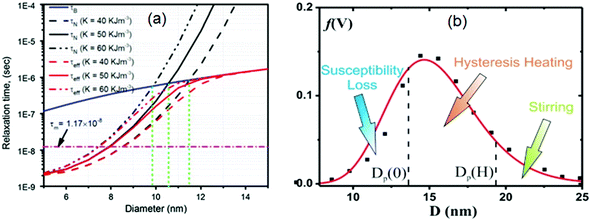
(a) Graphical representation of Brownian, Néel and effective relaxation times as a function of particle diameter for different values of anisotropy constant (K)4 and (b) representation of heating due to Néel and Brownian relaxations, and hysteresis loss

Evolution of magnetism on a curved nano-surface - Nanoscale (RSC Publishing)

Evolution of magnetism on a curved nano-surface.
D. G. Merkel, D. Bessas, Z. Zolnai, R. Rüffer, A. I. Chumakov, H. Paddubrouskaya, C. Van Haesendonck, N. Nagy, A. L. Tóth and A. Deák
Nanoscale 7, 12878 (2015)
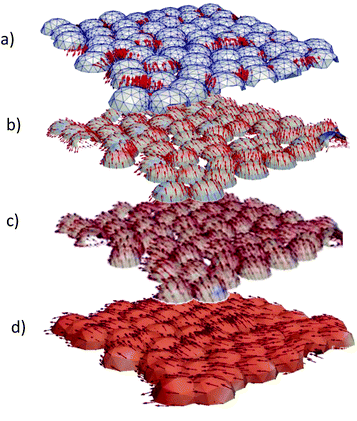
The magnetic moment configuration calculated by micromagnetic simulation for (a) 28 Å, (b) 38 Å, (c) 42 Å and (d) 72 Å iron thicknesses on 400 nm diameter spheres. The blue color represents the magnitude of the z component while the red stands for the x–y in-plane component. The non-magnetic part of the iron layer is shown in gray.

Magnetic moment configuration calculated by micromagnetic simulation for (a) 26 Å, (b) 34.5 Å, (c) 48.5 Å and (d) 70.5 Å evaporated iron thickness on 25 nm diameter spheres. The blue color represents the magnitude of the z component while the red stands for the x–y in-plane component.

Recent Advances in Biomedical Imaging Agents

Recent Advances in Higher-Order, Multimodal, Biomedical Imaging Agents.

James Rieffel, Upendra Chitgupi andJonathan F. Lovell
Small 11, 4445 (2015)

γFe2O3@Au Magnetic Gold Nanoflowers for Efficient Cancer Theranostics

Rational Design and Synthesis of γFe2O3@Au Magnetic Gold Nanoflowers for Efficient Cancer Theranostics.
Jie Huang, Miao Guo, Hengte Ke, Cheng Zong, Bin Ren, Gang Liu, He Shen, Yufei Ma, Xiaoyong Wang, Hailu Zhang, Zongwu Deng, Huabing Chen and Zhijun Zhang
An γFe2O3@Au core/shell-type magnetic gold nanoflower-based theranostic nano­platform is developed. It is integrated with ultrasensitive surface-enhanced Raman scattering imaging, high-resolution photo­acoustics imaging, real-time magnetic resonance imaging, and photothermal therapy capabilities


EB in molecular layers

Exchange bias and room-temperature magnetic order in molecular layers.
Manuel Gruber, Fatima Ibrahim, Samy Boukari, Hironari Isshiki, Loïc Joly, Moritz Peter, Michał Studniarek, Victor Da Costa, Hashim Jabbar, Vincent Davesne, Ufuk Halisdemir, Jinjie Chen, Jacek Arabski, Edwige Otero, Fadi Choueikani, Kai Chen, Philippe Ohresser, Wulf Wulfhekel, Fabrice Scheurer, Wolfgang Weber, Mebarek Alouani, Eric Beaurepaire, Martin Bowen

The red arrows represent the orientation of the spin moments. Note that the third layer dominantly exhibits a paramagnetic behaviour. The left inset represents the second-ML molecule on top of the semi-transparent first-ML molecule. The right inset shows the relative alignment of the second-ML molecule (semi-transparent) to the third-ML molecule.

Monday, 24 August 2015

LLBar phenomenological relaxation equation

Phenomenological description of the nonlocal magnetization relaxation in magnonics, spintronics, and domain-wall dynamics.
Weiwei Wang, Mykola Dvornik, Marc-Antonio Bisotti, Dmitri Chernyshenko, Marijan Beg, Maximilian Albert, Arne Vansteenkiste, Bartel V. Waeyenberge, Andriy N. Kuchko, Volodymyr V. Kruglyak, and Hans Fangohr
Phys. Rev. B 92, 054430 (2015)
The spin-wave-amplitude decay along the rod, for a spin wave excited locally by applying a microwave H=H0sin(2πft)ey of frequency f=30GHz and amplitude H0=1000Oe in the region 0≤x≤2nm. The data were fitted using Eq. (23) with β=0.02 and α=0.01.


Saturday, 22 August 2015

Exchange bias in Au-Fe3O4 dumbbell NPs

Exchange bias effect in Au-Fe3O4 dumbbell nanoparticles induced by the charge transfer from gold.
Mikhail Feygenson, John C. Bauer, Zheng Gai, Carlos Marques, Meigan C. Aronson, Xiaowei Teng, Dong Su, Vesna Stanic, Volker S. Urban, Kevin A. Beyer, and Sheng Dai
Phys. Rev. B 92, 054416 (2015)
Temperature-dependent ZFC and FC magnetizations for (a) Au-4 sample and (b) free solution of Fe3O4 and Au nanoparticles. The field-dependent magnetization measured after field cooling in 50 kOe from 300 K for (c) Au-4 and (d) reference samples at various temperatures. Inset: the same plot at lower fields, showing no horizontal shift of the hysteresis loop.

Multiscale modeling of ultrafast magnetization dynamics of ferromagnetic alloys

Multiscale modeling of ultrafast element-specific magnetization dynamics of ferromagnetic alloys.
D. Hinzke, U. Atxitia, K. Carva, P. Nieves, O. Chubykalo-Fesenko, P. M. Oppeneer, and U. Nowak
Phys. Rev. B 92, 054412 (2015)
Ratio between the relaxation times τ of the Fe and Ni sublattices in Py after the application of a heat pulse of temperature Tpulse for a range of values of the ratio of intrinsic damping parameters λFe/λFe. Black lines represent λFe/λNi values where the ratio between relaxation times τNi and τFe is constant with the value given by the label.

Magnetic order induced by torsion in magnetic nanowires

Torsion-induced effects in magnetic nanowires.
Denis D. Sheka, Volodymyr P. Kravchuk, Kostiantyn V. Yershov, and Yuri Gaididei

Phys. Rev. B 92, 054417 (2015)

Magnetization distributions in the helix wire with easy-tangential anisotropy and C=+1 obtained from numerical simulations
Equilibrium magnetization distribution in the quasitangential state of the helix wire with C=+1

AF proximity effect in Co NPs

High Temperature Magnetic Stabilization of Cobalt Nanoparticles by an Antiferromagnetic Proximity Effect.
José A. De Toro, Daniel P. Marques, Pablo Muñiz, Vassil Skumryev, Jordi Sort, Dominique Givord, and Josep Nogués

Phys. Rev. Lett. 115, 057201 (2015)

(a) Schematic representation of the Co/CoO−NiO sample. (b) Field-cooled hysteresis loops of the Co/CoO−NiO samples (S series) at 10 K. Shown in the inset is the 10-K hysteresis loop of R80. (c) Field-cooled hysteresis loops of the same samples at 300 K. Shown in the inset are the same loops up to higher fields.


Tuesday, 21 July 2015

Size dependent Verwey transition

Size Dependence of Metal–Insulator Transition in Stoichiometric Fe3O4 Nanocrystals.
Jisoo Lee, Soon Gu Kwon, Je-Geun Park, and Taeghwan Hyeon
Nano Lett. 15, 4337 (2015)
Size dependence of TV for Fe3O4 NCs. The contour plot represents the heat capacity data after removing the contribution of surfactant. The symbols mark the Verwey transition temperature (TV) determined from three different types of measurements: heat capacity (green, CP/T), conductance (blue, G), and magnetic moment (red, m). The size dependence of blocking temperature (TB) is also plotted from the same magnetization measurement (black). The gray line is a guide to the eye for the size dependence of TB.
 

Monday, 20 July 2015

Magnetic Interactions and Energy Barrier Enhancement in Core/Shell Bimagnetic Nanoparticles - The Journal of Physical Chemistry C (ACS Publications)


Magnetic Interactions and Energy Barrier Enhancement in Core/Shell Bimagnetic Nanoparticles.
Gabriel C. Lavorato, Davide Peddis, Enio Lima , Jr., Horacio E. Troiani, Elisabetta Agostinelli, Dino Fiorani, Roberto D. Zysler, and Elin L. Winkler
J. Phys. Chem. C 119, 15755 (2015) 
In this work, we studied the dynamic and static magnetic properties of ZnO-core/CoFe2O4-shell and CoO-core/CoFe2O4-shell nanoparticles. Both systems are formed by a core of ∼4 nm of diameter encapsulated in a shell of ∼2 nm of thickness. The mean blocking temperature changes from 106(7) to 276(5) K when the core is diamagnetic or antiferromagnetic, respectively. Magnetic remanence studies revealed the presence of weak dipolar interparticle interactions, where Hint is approximately −0.1 kOe for ZnO/CoFe2O4 and −0.9 kOe for CoO/CoFe2O4, playing a minor role in the magnetic behavior of the materials. Relaxation experiments provided evidence that the magnetization reversal process of CoFe2O4 is strongly dependent on the magnetic order of the core. At 10 K, activation volumes of ∼46(6) and ∼69(5) nm3 were found for CoO/CoFe2O4 and ZnO/CoFe2O4 nanoparticles, respectively, corresponding to one-third and one-fifth of the total shell volume. While the magnetic behavior of ZnO/CoFe2O4 nanoparticles is strongly affected by the surface disorder, the exchange coupling at the CoO/CoFe2O4 interface rules the magnetization reversal and the nanoparticles’ thermal stability by inducing a larger energy barrier and promoting smaller switching volume.

Tuesday, 14 July 2015

Diversity of Hyperthermia Response

A Single Picture Explains Diversity of Hyperthermia Response of Magnetic Nanoparticles.

Ivan Conde-Leboran , Daniel Baldomir, Carlos Martinez-Boubeta, Oksana Chubykalo-Fesenko, María del Puerto Morales, Gorka Salas, David Cabrera, Julio Camarero, Francisco J. Teran, and David Serantes

Journal of Physical Chemistry C 119, 15698 (2015)


Addressing the Control of NP arrangement and performance in Hyperthermia

Nano-objects for Addressing the Control of Nanoparticle Arrangement and Performance in Magnetic Hyperthermia.
Irene Andreu, Eva Natividad, Laura Solozábal, and Olivier Roubeau

ACS Nano, 9 1408 (2015)

One current challenge of magnetic hyperthermia is achieving therapeutic effects with a minimal amount of nanoparticles, for which improved heating abilities are continuously pursued. However, it is demonstrated here that the performance of magnetite nanocubes in a colloidal solution is reduced by 84% when they are densely packed in three-dimensional arrangements similar to those found in cell vesicles after nanoparticle internalization. This result highlights the essential role played by the nanoparticle arrangement in heating performance, uncontrolled in applications. A strategy based on the elaboration of nano-objects able to confine nanocubes in a fixed arrangement is thus considered here to improve the level of control. The obtained specific absorption rate results show that nanoworms and nanospheres with fixed one- and two-dimensional nanocube arrangements, respectively, succeed in reducing the loss of heating power upon agglomeration, suggesting a change in the kind of nano-object to be used in magnetic hyperthermia.


Magnetism on a curved nano-surface

Evolution of magnetism on a curved nano-surface.
D. G. Merkel, D. Bessas, Z. Zolnai, R. Rüffer, A. I. Chumakov, H. Paddubrouskaya, C. Van Haesendonck, N. Nagy, A. L. Tóth and A. Deák
Nanoscale 7, 12878 (2015)
Magnetic moment configuration calculated by micromagnetic simulation for (a) 26 Å, (b) 34.5 Å, (c) 48.5 Å and (d) 70.5 Å evaporated iron thickness on 25 nm diameter spheres. The blue color represents the magnitude of the z component while the red stands for the x–y in-plane component.


Size effects on EB in NiO NPs

Scrutinizing the role of size reduction on the exchange bias and dynamic magnetic behavior in NiO nanoparticles.
N Rinaldi-Montes, P Gorria, D Martínez-Blanco, A B Fuertes, L Fernández Barquín, I Puente-Orench and J A Blanco
Nanotechnology 26, 305705 (2015)
(a)–(d) Magnetic hysteresis loops for samples D2, D4 and D9 measured at selected temperatures, (a) 2, (b) 20, (c) 140 and (d) 300 K (that corresponding to a bulk NiO standard is included for the sake of comparison). (e)–(h) Enlarged views of the central part of the loops, evidencing the decrease in HC and Mr with increasing temperature. The pictures inside (a)–(d) indicate the blocked/frozen (blue) or unblocked/unfrozen (red) regimes for the cores and shells, and correspond to samples D2 (top), D4 (middle) and D9 (bottom)
 

Tuesday, 23 June 2015

Heusler alloys for giant exchange bias

Design of compensated ferrimagnetic Heusler alloys for giant tunable exchange bias.
Ajaya K. Nayak, Michael Nicklas, Stanislav Chadov, Panchanana Khuntia, Chandra Shekhar, Adel Kalache, Michael Baenitz, Yurii Skourski, Veerendra K. Guduru, Alessandro Puri, Uli Zeitler, J. M. D. Coey & Claudia Felser
Nature Materials 14 679 (2015)
a, Uncompensated magnetization, M, in Mn3−xPtxGa going through a compensation point (M = 0) at x = 0.59 (upper panel): squares are results from theoretical calculations. The line is a guide to eye. Lower panel: Experimental EB field HEB…


Monday, 22 June 2015

Skyrmion deformation in strained crystals

Large anisotropic deformation of skyrmions in strained crystal.

K. Shibata, J. Iwasaki, N. Kanazawa, S. Aizawa, T. Tanigaki, M. Shirai, T. Nakajima, M. Kubota, M. Kawasaki, H. S. Park, D. Shindo, N. Nagaosa & Y. Tokura

Nature Nanotechnology 10, 589 (2015)
Evaluation of SkX deformation in reciprocal space. a,b, FFT patterns of the over-focused Lorentz TEM images in Fig. 1c (at 260 K) and
Fig. 1d (94 K). c,d, FFT patterns of simulated SkX spin configurations under isotropic and anisotropic DMIs, respectively. Fitting ellipses of the six spots corresponding to magnetic modulation vectors are denoted by dashed curves in a–d. e, SkX deformation parameters a (long axis of the fitting ellipse), b (short axis) and f = 1 − b/a as functions of temperature T (upper abscissa) and estimated strain ε (lower abscissa). f, SkX deformation parameters a, b and f in simulated SkX spin configurations as a function of the degree of introduced DMI anisotropy η = 1 − Dx/Dy.
 

Universal dependence of SW in magnonic crystals

Universal dependence of the spin wave band structure on the geometrical characteristics of two-dimensional magnonic crystals.

S. Tacchi, P. Gruszecki, M. Madami, G. Carlotti, J. W. Kłos, M. Krawczyk, A. Adeyeye, G. Gubbiotti 

Scientific Reports 5, 10367 (2015)


(a) BLS spectra taken at the Γ-point for the series S1 ADLs with different thicknesses applying a magnetic field μ0H0 = 0.1 T. (b) Calculated SW spatial profiles for the edge (E), the fundamental (F) and the fundamental-localized (Floc) modes. The intensity of the color denotes the amplitude of the excitation, while the red and blue colors indicate opposite phase.

Friday, 12 June 2015

Skyrmion magnonic crystals

Skyrmion-Based Dynamic Magnonic Crystal.
Fusheng Ma, Yan Zhou, H. B. Braun, and W. S. Lew

Nano Letters 15, 4029 (2015)

A linear array of periodically spaced and individually controllable skyrmions is introduced as a magnonic crystal. It is numerically demonstrated that skyrmion nucleation and annihilation can be accurately controlled by a nanosecond spin polarized current pulse through a nanocontact. Arranged in a periodic array, such nanocontacts allow the creation of a skyrmion lattice that causes a periodic modulation of the waveguide’s magnetization, which can be dynamically controlled by changing either the strength of an applied external magnetic field or the density of the injected spin current through the nanocontacts. The skyrmion diameter is highly dependent on both the applied field and the injected current. This implies tunability of the lowest band gap as the skyrmion diameter directly affects the strength of the pinning potential. The calculated magnonic spectra thus exhibit tunable allowed frequency bands and forbidden frequency bandgaps analogous to that of conventional magnonic crystals where, in contrast, the periodicity is structurally induced and static. In the dynamic magnetic crystal studied here, it is possible to dynamically turn on and off the artificial periodic structure, which allows switching between full rejection and full transmission of spin waves in the waveguide. These findings should stimulate further research activities on multiple functionalities offered by magnonic crystals based on periodic skyrmion lattices.
  

Thursday, 11 June 2015

The design and verification of MuMax3

The design and verification of MuMax3
Arne Vansteenkiste, Jonathan Leliaert, Mykola Dvornik, Mathias Helsen, Felipe Garcia-Sanchez, and Bartel Van Waeyenberge
AIP Advances 4, 107133 (2014)

(dots) and OOMMF (lines) solution to standard problem #4a (top graph) and #4b (bottom graph), as well as space-dependent magnetization snapshots when < > crosses zero, for fields (a) and (b). All use a 200 × 50 × 1 grid.


Friday, 5 June 2015

Cobalt-Ferrite Nanoparticles for permanent magnets

Exploring the Magnetic Properties of Cobalt-Ferrite Nanoparticles for the Development of aRare-Earth-Free Permanent Magnet.
Alberto López-Ortega, Elisabetta Lottini, César de Julián Fernández, and Claudio Sangregorio

Chemistry of Materials 27, 4048(2015)
We present for the first time an in-depth magnetic characterization of a family of monodisperse cobaltferrite nanoparticles (NPs) with average size covering a broad range of particles sizes (from 4 to 60 nm), synthesized by thermal decomposition of metal−organic precursors. Metal precursors, surfactants, and synthetic parameters were settled in order to fine-tune the particle size, which preserves a narrow particle size distribution.

Magnonics: Special Reviews in Nature Phys.

Reconfigurable magnonics heats up.

Dirk Grundler
Nature Physics 11, 438(2015) 
Applying heat with a specific spatial periodicity to a magnet gives rise to periodically modulated magnetic properties. Stop bands (forbidden frequency gaps) for spin waves (cyan) occur. As a consequence, signal transmission is not allowed.

Magnon spintronics:  Review
A. V. Chumak, V. I. Vasyuchka, A. A. Serga & B. Hillebrands
Information coded into charge or spin currents is converted into magnon currents, processed within the magnonic system and converted back.

Thursday, 4 June 2015

Atomistic spin dynamics: Review


Atomistic spin dynamics and surface magnons.
Corina Etz, Lars Bergqvist, Anders Bergman, Andrea Taroni and Olle Eriksson
Journal of Physics: Condensed Matter 27, 243202 
 Bridging the gap: the ASD link between ab initio methods and micromagnetics simulations.